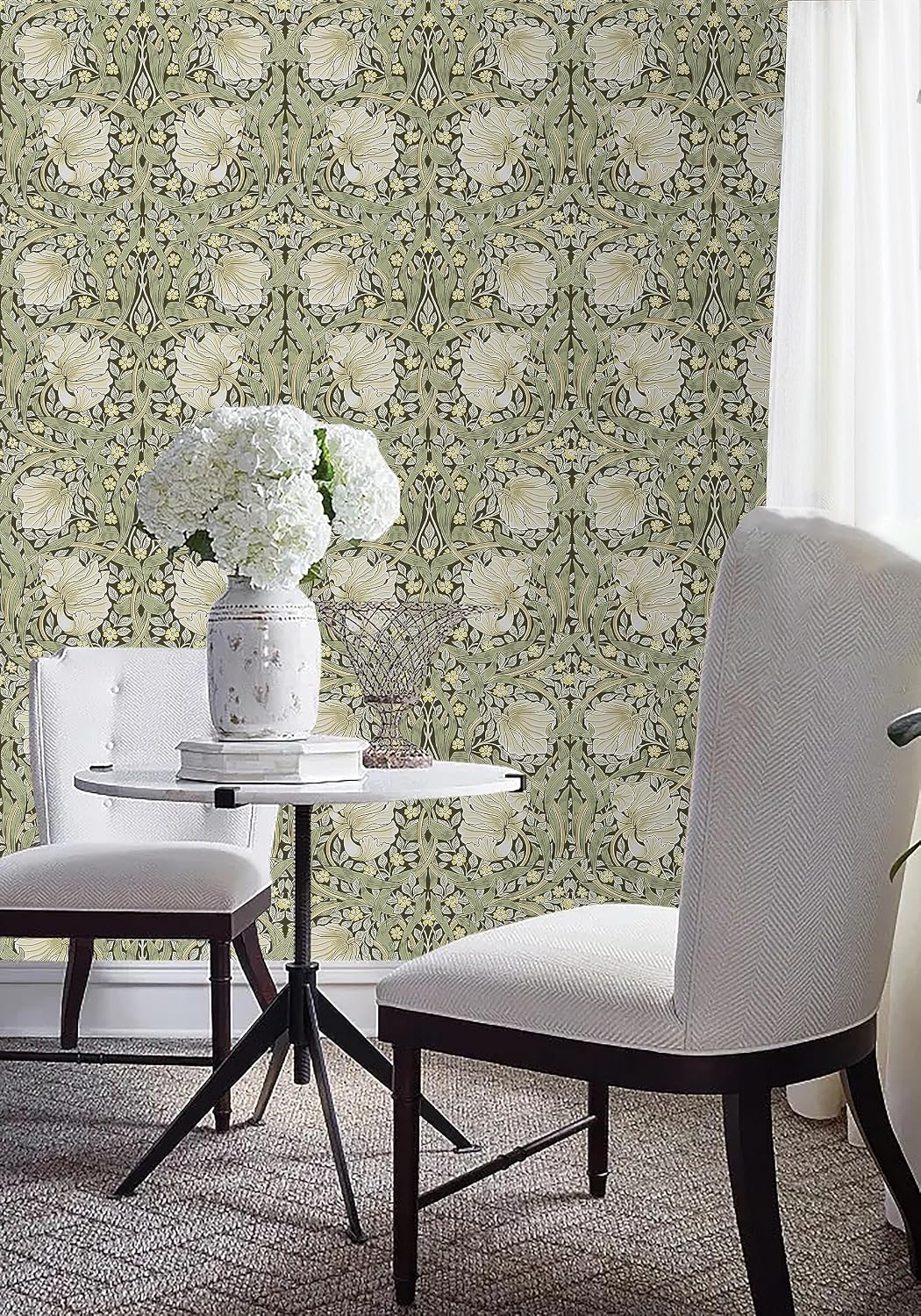
You spotted a gorgeous “Willow Bough” print on a mood board and now you’re three tabs deep trying to figure out whether the £45-per-roll listing on an unfamiliar site is the same thing as the £120-per-roll version at a heritage supplier. Welcome to one of the most confusing corners of the wallpaper market. William Morris designs — the dense, layered botanical patterns he created in the 1870s–90s for his firm Morris & Co. — are among the most widely reproduced decorative prints in history. That’s both a gift and a trap. Because Morris’s core patterns (Strawberry Thief, Acanthus, Willow Bough, Marigold) entered the public domain, anyone can print them. What varies enormously is print resolution, colorway fidelity, paper weight, and — the one that blindsides even experienced buyers — pattern repeat, meaning the vertical distance at which the design tiles and restarts, which determines how much wallpaper you actually need to buy and how much you’ll waste aligning it.
This guide is for buyers who already know the vocabulary but are mid-decision: you’re comparing two or three vendors, you have a room measurement in hand, and you need a framework for judging quality and calculating quantity before you commit. We’ll move through print authentication signals, substrate and finish choices, the repeat-math that trips people up, and a clear decision rule at the end.
| EDITOR'S PICK[Zeeko Large Floral Peel and Sti…](https://www.amazon.com/dp/B0CDWP69W4?tag=greenflower20-20) | Mid-tier[HAOKHOME Vintage Floral Wallpap…](https://www.amazon.com/dp/B0GS9PSG1X?tag=greenflower20-20) | Budget pick[Rustic Boho Wallpaper Peel and…](https://www.amazon.com/dp/B0D8PD15MB?tag=greenflower20-20) | |
|---|---|---|---|
| Size | 148" x 98" | 17.3" x 9.8' | 17.5" x 78.7" |
| William Morris | ✗ | ✓ | ✗ |
| Waterproof | — | — | ✓ |
| Price | $153.89 | $16.99 | $11.99 |
| See on Amazon → | See on Amazon → | See on Amazon → |
How to Identify a Quality William Morris Reprint
The original Morris & Co. designs were block-printed or woven — processes that produced slightly irregular, richly saturated color. Modern reprints range from faithful archival reproductions to thin digital prints that lose the depth entirely. Here’s what to check before ordering a sample (and yes, order the sample — ideally from two or three vendors side by side).
Color depth and registration. Authentic Morris patterns use layered, semi-transparent color fields — the indigo-and-madder combinations in Strawberry Thief, for instance, create a depth that flat digital printing flattens out. The Victoria and Albert Museum’s archive records note that Morris was explicit about avoiding “crude chemical dyes” in favor of vegetable and mineral pigments. Quality modern reprints from licensed producers like Morris & Co. by Sanderson (now part of the Sanderson Design Group) or Zoffany replicate this through high-pass digital printing on heavier substrates, usually 118–148 gsm (grams per square meter, the standard measure of paper weight). Reviewers at Wallpaper* Magazine’s 2025–2026 botanical roundup consistently flag color saturation as the clearest quality divider between heritage reprints and economy versions.
Substrate weight and texture. Morris’s original papers had a slight tooth — a textured surface that caught light differently across the day. Budget reprints on thin, smooth paper (under 100 gsm) look flat against a wall and are prone to tearing at seams. Licensed reprints from Sanderson Design Group and Cole & Son typically use non-woven (also called “vlies”) substrates, which are dimensionally stable, paste-the-wall friendly, and much more forgiving to hang than traditional wet paper. If a listing doesn’t specify gsm or substrate type, that’s a yellow flag.
Colorway count. Morris himself produced many of his designs in multiple colorways — Willow Bough came in at least four. A quality reproduction supplier will offer at least three to five colorways, cross-referenced to their archive origins. A supplier offering a single generic “blue/green” version is almost certainly working from a low-res scan rather than an archival source.
License and provenance statement. Sanderson Design Group holds many of the original Morris & Co. archive blocks and colorway specifications. Cole & Son has licensed several designs directly. When a listing says “inspired by William Morris” rather than citing a specific archive source or license, assume the colorway matching is approximate. As Architectural Digest noted in its 2024 feature on the Morris revival, the difference between an archive-matched reproduction and a “inspired by” print is visible at three feet — not just in photographs.
Pattern Repeat: The Math That Blows Budgets
This is where even design-forward buyers get caught out. A pattern repeat is the vertical distance (measured in inches or centimeters) before the design cycles back to its starting point. For a straight match, every strip needs to start at the same point in the pattern. For a drop match (also called a “half-drop”), alternating strips offset by half the repeat height — meaning you cut from two rolls simultaneously to avoid wasting an entire repeat from a single roll.
Morris’s iconic large-scale prints have significant repeat heights:
| Pattern | Typical Repeat Height | Match Type |
|---|---|---|
| Acanthus | 26.8 in (68 cm) | Straight match |
| Strawberry Thief | 9.6 in (24.4 cm) | Straight match |
| Willow Bough | 21.3 in (54 cm) | Straight match |
| Marigold | 10.8 in (27.4 cm) | Half-drop match |
By the numbers: On a room with 8-ft (244 cm) ceilings, a 26.8-inch repeat means each strip requires approximately 130 cm of usable paper to yield a full-height drop — that’s 54 cm of waste per strip before you account for ceiling height. On a 12-strip room, that’s roughly 6.5 meters of pure pattern-matching waste. At £12/meter for a mid-range print, that’s £78 in material you’re cutting off the floor. On a premium heritage reprint at £30+/meter, it’s £195.
The Spruce’s explainer on wallpaper pattern repeats lays out the standard industry formula cleanly: divide your wall height by the repeat height, round up to the nearest whole number, multiply by the repeat height, and use that adjusted figure as your effective strip length. Then divide total wall perimeter (minus doors and windows, conservatively) by roll width to get strip count, and multiply by adjusted strip length to get total linear footage.
The trap most buyers fall into: calculating based on raw wall height rather than the repeat-adjusted strip length. A room that appears to need 40 linear meters can actually require 52–55 meters of a large-repeat pattern. House Beautiful’s wallpaper calculation guide recommends always adding a 15% buffer on top of repeat-adjusted math — and bumping that to 20% for any pattern with a repeat over 20 inches. That buffer also covers dye-lot variation between rolls ordered at different times, which is a real risk on heritage reprints with hand-mixed colorways.
Substrate and Finish Decisions for Morris and Botanical Prints
Once you’ve confirmed print quality, you’re choosing between three substrate families:
Traditional wet paper (unpasted, pre-pasted). This is how Morris’s originals were hung. Wet paper expands when paste is applied, which means seams can bubble if you rush, and you need a paperhanger — ideally NGPP-certified (the National Guild of Professional Paperhangers designation, which signals training in seam alignment, substrate prep, and pattern matching) — rather than a general contractor comfortable with peel-and-stick. The dimensional shift of wet paper also means your installer needs to account for the repeat shifting slightly as the paper expands. For a 12-panel Acanthus installation, this is a non-trivial skill requirement.
Non-woven (vlies). The current standard for most quality reprints from Sanderson, Cole & Son, and similar. Dimensionally stable — it doesn’t expand when wet — which makes seam alignment on large repeats significantly more predictable. Paste-the-wall application (you apply paste to the wall surface rather than the paper) is cleaner. Pattern registration on a 26-inch repeat is still skilled work, but the margin for error is wider than with traditional wet paper. Most intermediate installers comfortable with premium wallpaper can handle non-woven Morris prints.
Peel-and-stick. Available from mid-market vendors like Spoonflower and Society6, which both carry public-domain Morris prints. Peel-and-stick is appropriate for renters, low-commitment accent walls, and buyers in the $40–$200/panel range. The honest tradeoff: adhesion is temperature-sensitive, large repeats are harder to reposition once committed, and seam visibility is higher than with paste methods. If you’re investing in a licensed heritage reprint at £80+ per roll, peel-and-stick is the wrong substrate for the money.
Sampling Strategy Before You Commit
The standard recommendation in this category — echoed across professional forums and by trade suppliers — is to order four to six samples across different vendors before committing to a colorway. For Morris prints specifically, this matters more than average because:
- The same colorway name (“Indigo,” “Forest,” “Ochre”) is used by multiple vendors with no standard calibration.
- Color rendering on screens varies enough that two “identical” blues can look visibly different on-wall.
- Substrate weight affects how color reads against different lighting conditions — matte non-woven absorbs light differently than semi-gloss or vinyl-coated papers.
Request samples at least 30 × 30 cm (12 × 12 inches) — large enough to see at least one full repeat element. Pin them to the actual wall surface (not a sample board), live with them through a full morning-to-evening light cycle, and photograph them under both natural and artificial light. This is especially critical for Morris designs in cool blues or deep reds, which can shift dramatically from daylight to incandescent evening light.
True Cost: What You’re Actually Spending
For a standard dining room (roughly 200 sq ft of wallable surface):
- Heritage licensed reprint (Sanderson/Cole & Son tier, £80–£120/roll, 10-meter rolls at 52 cm width): expect 8–12 rolls at mid-repeat, plus 15–20% buffer. Materials alone: £800–£1,700 before shipping and duties. Add £400–£800 for an NGPP-certified installer on a complex repeat. True project cost: £1,200–£2,500.
- Mid-market licensed reprint (US vendors like Rifle Paper Co. or Burke Décor, $60–$100/double roll): materials for the same room, $480–$900. General contractor installation if non-woven, $250–$500. True project cost: $730–$1,400.
- Public-domain digital print (Spoonflower, peel-and-stick, $45–$65/panel at 24-inch width): 10–14 panels for the same room, $450–$910. DIY installation. True project cost: $450–$910 with higher seam-visibility risk on large repeats.
The Decision Rule
If you’re comparing vendors and feel the pull toward the lower-cost listing, run this filter:
- If the listing doesn’t specify gsm, substrate type, or match type — order a sample before anything else. The savings evaporate fast if you need to re-order after a pattern-match disaster.
- If the repeat exceeds 20 inches and you’re using a non-NGPP installer — budget an extra 20% material buffer, not 15%.
- If you’re in a rental or low-permanence situation — peel-and-stick from Spoonflower is a legitimate choice, but acknowledge the seam tradeoff upfront rather than hoping it won’t show.
- If colorway fidelity to an archival original matters to your client or your design brief — Sanderson Design Group or Cole & Son are the defensible choices, and the price premium is real but documented.
The one thing that’s true across every tier: the pattern repeat is not a detail you negotiate with after ordering. Calculate it before you buy, build in the buffer, and get the sample on the wall before you commit to 10 rolls. The designs Morris made 150 years ago are worth doing right — and right starts with the math.