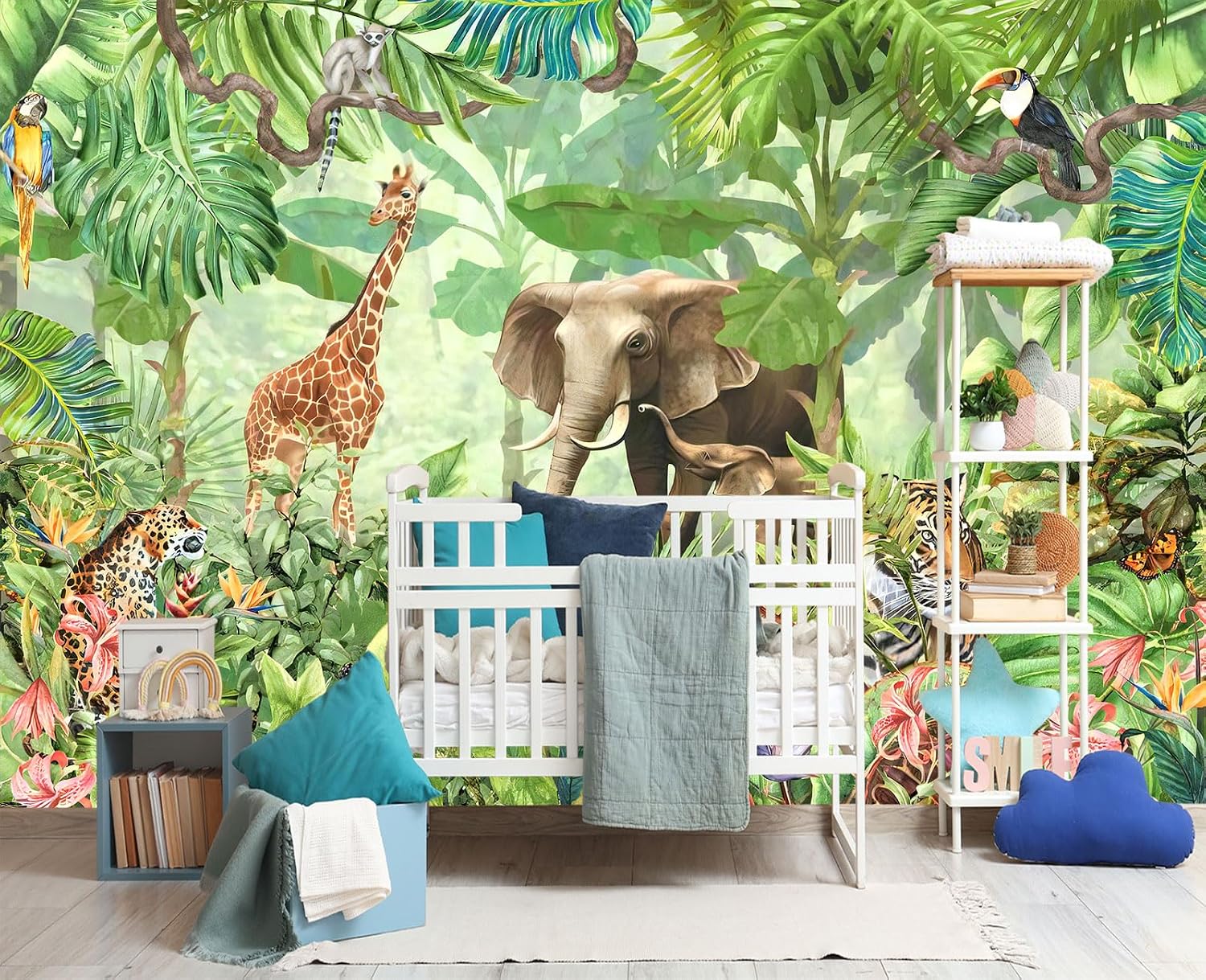
You just found a stunning tropical jungle mural on Instagram — cascading monstera leaves, birds of paradise, maybe a discreet toucan peeking through layered foliage — and now you’re trying to figure out whether it’s actually right for your nursery or living room. A scenic mural (a large-format, continuous wall image that wraps a room rather than repeating a small tile) sounds complicated, but the core decisions are more manageable than they look: pick a substrate (the material the print is on) that’s safe and appropriate for your wall and your room’s occupants, calculate how many panels you need so you don’t over- or under-order, and cross-check your shortlist against what real buyers have reported. That’s exactly what this guide does — with real numbers, named sources, and a clear decision framework at the end.
Substrate Safety: What “Non-Toxic” Actually Means in 2026
This is where nursery projects diverge sharply from living room projects, and where buyers most often underestimate the stakes.
The vocabulary you need first. Wallpaper substrates come in three broad families: paper (traditional cellulose-based, breathable, generally paste-applied), non-woven (a polyester-cellulose blend that’s dimensionally stable, paste-the-wall rather than paste-the-paper, and now the dominant professional substrate), and vinyl (a PVC-based film, durable and scrubbable, but associated with off-gassing concerns). On top of those substrates, inks matter: solvent-based inks cure with VOCs (volatile organic compounds — airborne chemicals that can irritate respiratory systems), while water-based and pigment inks are significantly lower in VOC output.
For nurseries specifically, The Spruce’s guide to nursery wallpaper is direct: look for products that carry GREENGUARD Gold certification (a third-party standard from UL that limits chemical emissions — relevant because infants breathe closer to surfaces and spend more hours in one room). Vinyl substrates with solvent inks are the combination to avoid. Non-woven substrates with water-based or pigment inks are the current consensus best practice for infant spaces.
Where does the jungle mural category sit? Across the mid-market brands most commonly cited by buyers in this category:
- Photowall (Sweden-based, ships to the US) prints on non-woven paper with water-based inks and publishes an Oeko-Tex Standard 100 certificate — a materials-safety standard that covers both the substrate and the colorants.
- Spoonflower (peel-and-stick and traditional options) uses water-based inks; their peel-and-stick product carries no specific VOC certification as of early 2026, but reviewers on Apartment Therapy’s roundup of peel-and-stick wallpapers consistently describe it as “odorless out of the package,” which aligns with water-based chemistry.
- Anthropologie / DENY Designs murals are typically non-woven with water-based inks; no GREENGUARD Gold on most SKUs as of this writing — worth confirming with their customer service before a nursery install.
- Burke Décor carries a curated selection where GREENGUARD Gold status varies by collection and manufacturer; their product pages now flag certification when it applies.
- Society6 operates on a print-on-demand model where substrate specs vary by product type; their standard wall mural uses a satin-finish polyester material — not ideal for nurseries without confirmed VOC data.
For living rooms, the calculus shifts. Scrubbability and durability move up the priority list, and a Type II vinyl (a thicker, commercial-grade PVC film rated for high-traffic surfaces) is entirely reasonable. The off-gassing concern for vinyl is real but time-limited: most of the VOC release happens in the first 48–72 hours after installation, during which you’d want the room well-ventilated regardless of substrate.
One number that matters:
GREENGUARD Gold limits total VOC emissions to 0.5 mg/m³ — a threshold set with children’s exposure in mind. Standard GREENGUARD (without Gold) allows 1.0 mg/m³. For nurseries, Gold is the bar worth holding to.
If a brand can’t provide a VOC certification or a specific Oeko-Tex certificate number on request, treat that as a red flag for nursery applications — not a dealbreaker for a living room, but worth noting.
Panel Count: The Math That Prevents Expensive Mistakes
Scenic murals are sold differently from repeat-pattern wallpaper, and buyers who approach them with a repeat-wallpaper mindset routinely over- or under-order. Here’s the framework.
How scenic murals are structured. Most brands sell jungle murals as a set of panels — typically 2, 3, 4, or 5 vertical strips that together compose the full image. Each panel is a fixed width (commonly 18–24 inches) and a standard height (usually 98–110 inches, designed to cover a standard 8- or 9-foot ceiling with trim allowance). The mural image is engineered so panel 1 + panel 2 + panel 3 = one complete scene with no repeating.
The calculation. You need two measurements: your wall’s width in inches, and your wall’s height in inches (floor to ceiling, measured in at least three spots — take the largest number).
- Divide your wall width by the panel width for that product. Round up to the nearest whole panel.
- Check whether the panel height covers your ceiling height plus 4–6 inches of trim allowance (2–3 inches top and bottom for cutting). If not, you need a custom height order or a stacked panel configuration, which most brands offer at additional cost.
- If you’re papering more than one wall (a full wrap, common in nurseries), repeat the calculation per wall and sum the panels.
A worked example:
- Nursery accent wall: 144 inches wide × 96 inches tall
- Photowall panel width: 23.6 inches (standard)
- Panels needed: 144 ÷ 23.6 = 6.1 → order 7 panels (the extra panel covers cutting error and pattern alignment at the ceiling)
- Panel height: 110 inches — covers 96 inches plus 14 inches of trim allowance. ✓
That seventh panel is your insurance. Scenic murals can’t be reordered mid-project and perfectly color-matched to an earlier print run; paper and inks shift subtly between batches. House Beautiful’s jungle wallpaper feature reinforces this: “order one panel more than math suggests and store it flat — you’ll thank yourself if a seam tears during installation.”
By the numbers — typical panel counts by room type:
| Room | Typical wall width | Panels needed (23.6” panel) |
|---|---|---|
| Nursery accent wall | 10–12 ft | 6–7 |
| Living room accent wall | 12–16 ft | 7–9 |
| Full nursery wrap (3 walls) | 36–42 ft total | 19–22 |
| Boutique hotel lobby feature | 16–24 ft | 9–13 |
What Reviewers Actually Say: Patterns Across the Category
No single brand dominates this space cleanly. Here’s what aggregated buyer reporting surfaces across the jungle-mural category as of mid-2026.
Photowall earns consistent praise for color accuracy relative to on-screen previews — a meaningful differentiator because jungle murals live or die on the depth of greens and the saturation of accent colors (the gold of a bird’s beak, the rust of a bromeliad). Apartment Therapy’s peel-and-stick roundup notes that Photowall’s traditional non-woven option “installs flatter and holds seams better” than their peel-and-stick variant, which reviewers say can bubble in humid rooms. For a nursery in a climate-controlled interior, either works; for a bathroom-adjacent nursery or a living room with significant temperature swings, the traditional paste version is the more reliable call.
Spoonflower occupies a different niche: the designs are artist-sourced, the price-per-panel is lower, and the peel-and-stick format appeals to renters. The tradeoff reviewers flag consistently is print resolution on highly detailed jungle imagery — fine botanical linework can look softer in person than in product photography. Owners of Spoonflower jungle murals in nurseries report satisfaction with the overall effect at distance but note that close-up detail (leaf veining, bird feather texture) reads less crisply than mid-market competitors.
Anthropologie’s mural offering generates strong emotional response — buyers love the artistic curation — but the most common complaint in reviews is lead time variability. For nursery timelines (where you’re working against a due date), Architectural Digest’s 2025 wallpaper trend coverage flags that “made-to-order and print-on-demand formats add 2–6 weeks to project timelines” compared to in-stock panels.
At the premium end, Fromental’s hand-painted chinoiserie jungle panels — the kind Dezeen covered in their feature on hand-painted wall art’s commercial resurgence — operate on a completely different timeline and price point (projects typically start at $1,000 per panel, with 12–20 week lead times for bespoke colorways). Reviewers in that tier are hospitality designers and high-end residential clients; their feedback consistently centers on the irreproducibility of the work — the way natural pigment variation across hand-painted panels creates a living, non-mechanical image. That’s the right call for a hotel lobby or a principal bedroom feature wall; it’s genuinely not the right call for a nursery where the wall may be repainted in five years.
Installation patterns worth knowing. Across buyer reports, the most common failure point for jungle murals isn’t the product — it’s the installer. Non-woven murals are paste-the-wall (you apply paste to the wall surface, not the paper), which is counterintuitive for general contractors trained on older paste-the-paper techniques. Wallpaper Magazine’s coverage of large-format mural installation notes that misapplication of paste to non-woven substrates is the leading cause of bubbling and seam failure. For any panel set over six pieces wide, the National Guild of Professional Paperhangers (NGPP) recommends using a certified installer — not because the work is impossible for a skilled DIYer, but because a six-panel jungle mural is not the project to learn on.
The Decision Framework: If X, Then Y
Here’s how to use everything above:
If it’s a nursery install: GREENGUARD Gold or Oeko-Tex Standard 100 is non-negotiable. Photowall’s non-woven traditional option is the most defensible choice on safety documentation. Confirm certification currency directly with the brand before ordering — certifications lapse and product lines change.
If it’s a living room with high humidity or temperature variation: Avoid peel-and-stick regardless of brand. Non-woven with a paste-the-wall installation holds under environmental stress where peel-and-stick adhesives fail.
If your wall width is 12 feet or less: Mid-market brands (Photowall, Burke Décor’s curated selections) at the $300–$800 range for a full panel set are well-matched to the project scale. Order one panel above your calculated count.
If your wall width exceeds 14 feet, or you’re papering three walls: Get an NGPP-certified installer in the room before you order — wall irregularities, outlet placements, and corner seaming decisions affect your final panel count more than the formula does. Many NGPP installers will do a pre-order site visit for a flat fee that pays for itself in avoided waste.
If the project is a hotel lobby, boutique hospitality space, or principal bedroom with a five-figure renovation budget: Request samples from Fromental, Gracie Studio, or Timorous Beasties. The sample step is not optional — colorway variation between a digital swatch and a hand-painted or studio-produced panel under your actual lighting conditions is significant enough to change the order. The standard in this tier is four to six physical samples before committing to a bespoke order.
Next step: Use our panel calculator to model your wall dimensions against the panel widths of the specific brands you’re considering — it’ll surface your panel count, estimated cost range including paste and installation, and a checklist of the certification questions to ask before you order a sample.