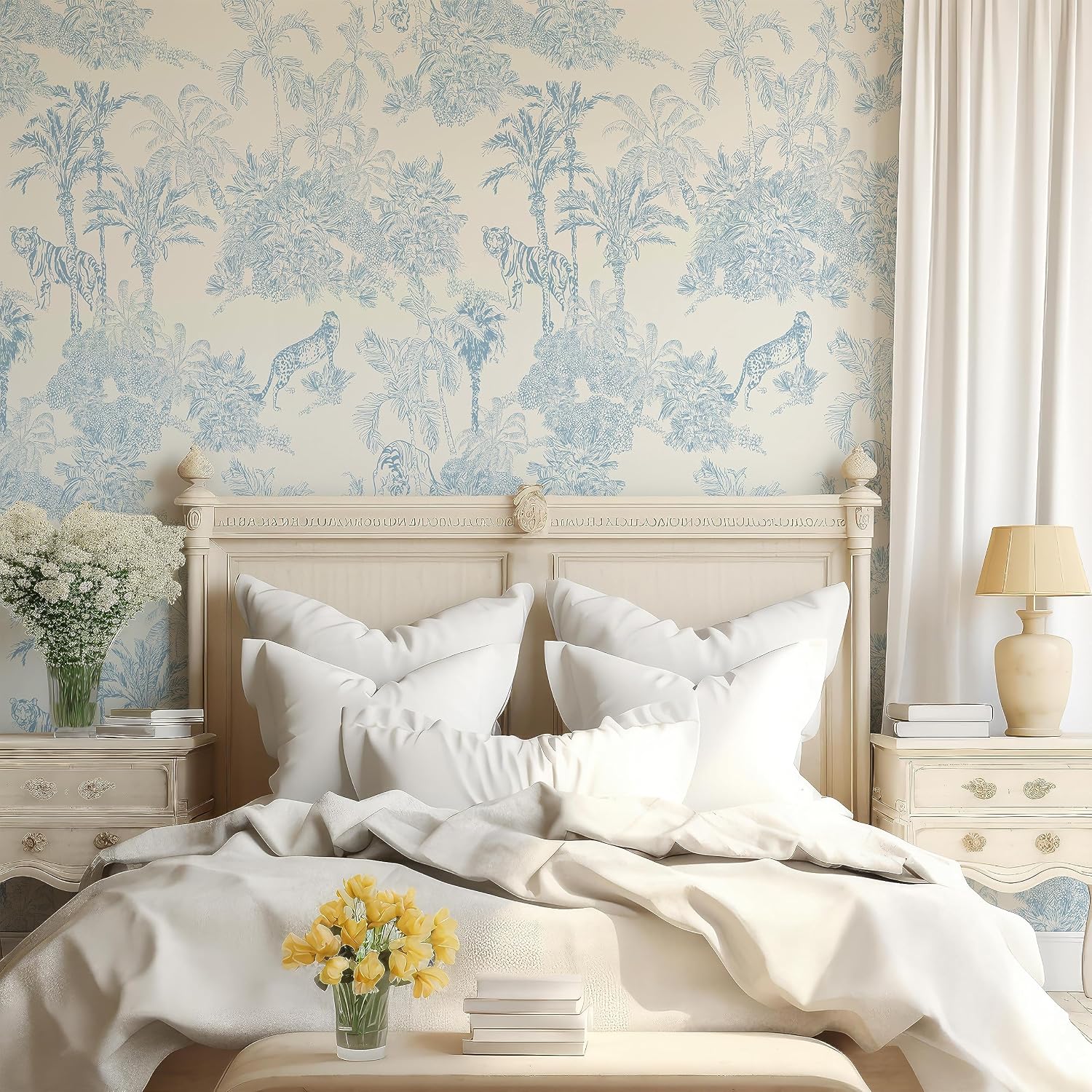
You just fell down an Instagram rabbit hole of beautiful rooms swathed in those elegant two-color printed scenes — shepherdesses, Chinese pagodas, hot-air balloons, pastoral villages — all rendered in a single ink color on a cream or white ground. That’s toile de Jouy (pronounced twahl duh ZHWEE), a printed fabric-and-wallpaper tradition that originated in the French town of Jouy-en-Josas in the 1760s. Today it’s experiencing a full-on design moment, appearing in updated colorways (dusty sage, terracotta, deep indigo) alongside the classic red-on-cream and blue-on-white. If you’re sourcing it for a client project or your own space, the aesthetic decision is the easy part. The harder parts — calculating how many rolls you actually need given a large repeating pattern, navigating wildly different sample policies across vendors, and knowing which rooms genuinely reward the investment versus which rooms will make it feel costume-y — are what this guide is for.
Why Pattern Repeat Math Hits Different With Toile
If you’ve ordered geometric or textured wallpaper before, you may have added a standard 10–15% overage and called it a day. With toile, that approach will leave you short. Here’s why.
Pattern repeat is the vertical distance between one point in a design and the next time that exact point appears. Standard repeats on solid or geometric papers run 12–18 inches. Toile de Jouy, because it tells a story across a landscape scene, routinely carries repeats of 24 to 36 inches — and some bespoke chinoiserie-adjacent toile panels from studios like Schumacher or Robert Kaufman’s licensed archives push past 48 inches. The Spruce’s wallpaper calculation guide notes that every full repeat you lose to trimming adds roughly one additional single roll (or one linear foot of mural panel) to your material requirement.
The math in plain terms:
- Measure your wall height from floor to ceiling (let’s say 108 inches / 9 feet).
- Divide by the usable roll length (typically 396 inches / 33 feet on a standard European double roll).
- That gives you drops per roll before accounting for repeat.
- Now divide your wall height by the pattern repeat to find how many full repeats fit. Round up to the next whole number, then multiply back by the repeat to get your actual cut length per strip.
- Divide your usable roll length by that cut length to get true drops per roll.
- Count your strips across the room width, divide by true drops per roll, and round up.
By the numbers — worked example:
- Room width: 14 ft (168 in), ceiling height: 9 ft (108 in), pattern repeat: 27 in
- Cut length per strip: ⌈108 ÷ 27⌉ = 4 repeats × 27 in = 108 in (no waste here — lucky)
- But if ceiling were 110 in: ⌈110 ÷ 27⌉ = 5 repeats × 27 in = 135 in per strip — 25 in of waste per strip
- Strips across room: ⌈168 ÷ 21 in roll width⌉ = 8 strips; drops per roll: ⌊396 ÷ 135⌋ = 2; rolls needed: 4 double rolls minimum — order 5
That fifth roll isn’t optional. Architectural Digest’s overview of scenic wallcovering installations consistently flags dye-lot matching as the single most expensive mistake buyers make; a roll ordered six months later almost never matches the original batch. Order the buffer roll now, store it flat, and return it if your installer confirms you’re clean.
Half-drop vs. straight-match repeats add another layer. Many toile patterns use a half-drop match — each strip must shift down by half the repeat value before it aligns with its neighbor. That burns material faster than a straight match. Check the product spec sheet before you calculate. Vendors including Farrow & Ball and Cole & Son mark this clearly; others bury it in the installation PDF.
Sample Policy: What You Should Actually Expect (and Demand)
Sample policy in the toile market is all over the map, and the gaps matter when you’re making a $1,500+ commitment. Here’s the framework across tiers.
Premium and bespoke (de Gournay, Gracie, Fromental): These studios don’t send mail-order samples — they schedule a design consultation and show you large memo samples or hand-painted swatches at a showroom or via their trade rep. Lead times on samples can run 2–4 weeks. This is standard and reasonable given that every colorway is mixed to order. Elle Decor’s coverage of bespoke wallcovering studios confirms that most premium houses expect a signed project agreement before committing sample yardage; don’t read that as obstruction — it’s how they protect hand-painted inventory.
Mid-market (Schumacher, Cole & Son, Waverly, Rifle Paper Co.): Most offer memo samples (typically 8.5” × 11” or A4) for $3–$8 each, returnable for credit in some cases. The standard guidance in this tier — which House Beautiful’s scenic wallpaper buying guide reinforces — is order 4–6 samples minimum: at least two for color-checking under different lighting conditions, one to hold against your trim, one for the client file, and one spare. Don’t order a single sample and make a decision on a laptop screen. Toile colorways shift dramatically under incandescent versus natural light.
Entry/mid-market digital (Spoonflower, Photowall, Wallsauce): Samples are typically 8” × 8” to A4, priced $1–$5, with fast turnaround (3–5 business days). Wallpaper Magazine’s 2025 state-of-the-market review noted that digital-print toile reproductions now rival offset-printed quality at the entry tier, but color calibration between monitor and output still varies by 10–20% in saturation. Order a sample. Always.
If X, then Y on sampling:
- If you’re ordering under $400 total → order 2 samples minimum, focus on one under your room’s actual lighting
- If you’re ordering $400–$1,500 → order 4–6 samples, check against existing fabrics and trim
- If you’re ordering $1,500+ or it’s a client project → request a full-width memo (12”–24” wide) and insist on a confirmed dye-lot number before committing
One non-negotiable regardless of tier: ask whether samples come from the same production run as the stock you’d order. Some vendors pull samples from a display roll that’s 18 months old. That’s a dye-lot mismatch waiting to happen.
The Rooms Where Toile Actually Earns Its Place
Toile is a loud pattern with a strong personality. Placing it well is a skill; placing it everywhere is a mistake. Here’s an honest room-by-room breakdown based on documented designer usage and owner-reported outcomes.
Dining rooms — high confidence. This is toile’s native habitat. The pattern’s narrative quality rewards close looking, and dining rooms give people time to look. Designers cited in Architectural Digest’s toile roundup consistently anchor it here, often taking it floor-to-ceiling and onto the ceiling plane for a tent effect. The contained, boxy geometry of most dining rooms also makes pattern repeat math more forgiving — fewer angled cuts, fewer obstacles.
Principal bedrooms — confident with conditions. Toile works beautifully on a single feature wall behind the bed, or on all four walls if the ceiling is high (9 ft+) and the other furnishings are disciplined. Where it fails: small bedrooms with sloped ceilings or lots of windows and doors, where constant pattern interruptions fragment the narrative and make the room feel restless. Veranda magazine’s bedroom design surveys consistently flag visual “choppiness” as the top owner complaint in toile bedrooms — almost always traced to insufficient wall real estate per strip.
Powder rooms — very high confidence. Small, high-impact, low-risk. You’re using 2–4 rolls maximum, which limits financial exposure. The intimacy of the space means the pattern’s detail reads at conversational distance. This is where first-time toile buyers should experiment.
Nurseries — moderate confidence, check colorways. Toile has a long history in nursery design (pastoral scenes, animals, storybook imagery all fit the brief). The risk: some traditional red-on-cream or black-on-white colorways read too adult or too graphic at small scale. Sage, blush, and dusty blue toiles work better in this context — owner reviews on mid-market platforms like Burke Décor and Rifle Paper Co.’s site consistently rate softer colorways higher in nursery applications.
Living rooms — proceed carefully. The living room’s visual complexity — multiple seating orientations, varied lighting zones, TV walls, art placement — tends to fight with toile’s own strong visual content. It works in formal sitting rooms with minimal art and symmetrical furniture arrangements. It rarely works in open-plan living areas where the pattern must compete with kitchen cabinetry, dining furniture, and multiple sight lines.
Kitchens — not recommended. Moisture, grease, and frequent cleaning are hard on any wallcovering, and toile’s typically matte or low-sheen surface compounds that problem. If a client insists, specify a vinyl-coated or washable substrate — but know that the coating will flatten the pattern’s fine engraving detail, which is toile’s primary visual asset.
Substrate, Installer, and True Cost — The Numbers You Need Before You Commit
Toile de Jouy wallpaper is sold in three primary substrates, and the choice has real cost and installation implications.
Unpasted paper-backed is the traditional format for premium and bespoke toile. It requires a professional installer — ideally NGPP-certified (National Guild of Professional Paperhangers) — because alignment of a large-repeat scenic pattern tolerates almost zero error. Installer quotes from NGPP-member firms in 2025–2026 for a dining room application typically run $8–$15 per single roll in labor, per industry pricing surveys referenced in Wallpaper Magazine’s installer market update. Factor that into your budget before you fall in love with a price-per-roll figure.
Pre-pasted is the mid-market standard — easier for experienced DIYers, but still not beginner territory with a 27-inch repeat. The paste can dry unevenly, causing edge lifting in low-humidity rooms. Ask your vendor if they recommend a border adhesive as insurance.
Peel-and-stick toile exists at the entry tier (Spoonflower, Society6) and is genuinely renter-friendly. The tradeoff: repositionability comes at the cost of long-term edge adhesion, especially in rooms with humidity fluctuation. Owner reviews across aggregated sources consistently note edge lifting within 12–18 months in bathrooms and poorly heated rooms. For a dining room on a painted drywall surface in a climate-controlled home, reviewers report much better longevity.
True cost checklist per room:
- Material (rolls + 15–20% repeat overage buffer)
- Shipping (often $50–$200 for a full room order; customs duties if EU-sourced)
- Lining paper if walls are textured (add $1–$3 per sq ft)
- Paste and primer if unpasted
- Installer labor ($8–$15/roll for NGPP-certified)
- One buffer roll held in reserve (non-negotiable)
Your Decision Rule
If the room has 8+ uninterrupted feet of wall height, 4+ feet of unbroken wall width per strip, and you’re working with a palette of two to three colors maximum elsewhere in the space, toile de Jouy will reward you. Run the repeat math before you order, request samples in the 4–6 range, confirm your dye lot, and budget for professional installation on anything unpasted.
If the room has lots of interruptions — windows every few feet, sloped ceilings, open-plan adjacencies — toile will fragment into visual noise and you’ll spend twice on material for half the effect. A solid texture or a simpler geometric scenic pattern will serve the space better.
Use our room calculator to model your true panel count before you commit to a vendor, and order those samples first. The pattern’s beauty is in the details — and you need to see those details on your actual walls, under your actual light, before the rolls arrive.