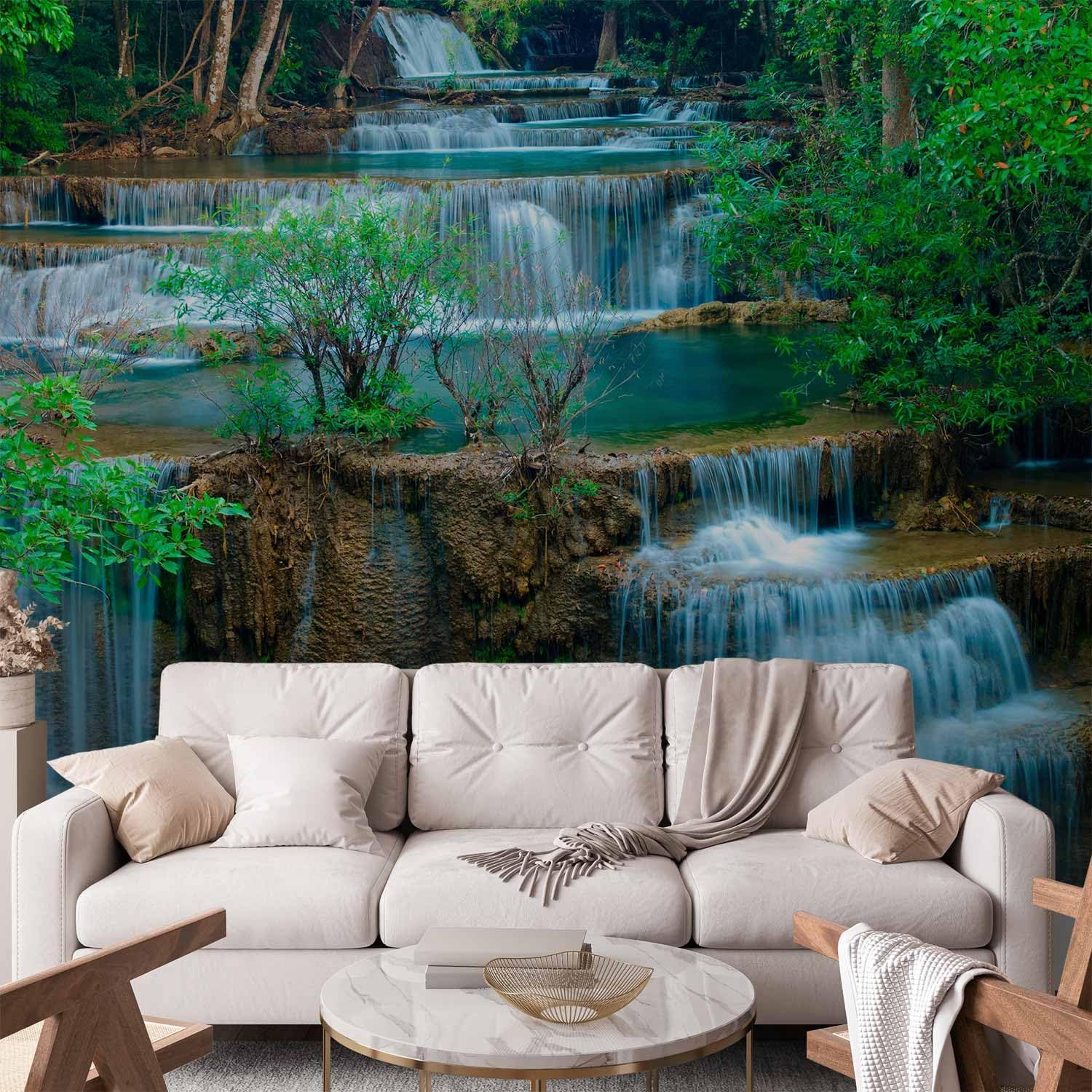
You just found the perfect scenic mural on Instagram — a floor-to-ceiling woodland panorama, or maybe a sweeping chinoiserie (pronounced “sheen-wah-ZEE-ree,” referring to European-style decorative art inspired by East Asian motifs) landscape that would anchor your client’s principal bedroom. The vendor’s website quotes a panel price. You do some rough math. It seems… manageable. Then the invoice arrives and it’s 40% higher than you expected.
That gap isn’t a surprise to anyone who’s been through the process once, but it derails first-timers and even experienced decorators who skip the modeling step. A scenic landscape mural — a large-format, continuous wall image printed or hand-painted across multiple vertical panels — is not a per-roll commodity purchase. It’s a project-within-a-project, with a cost structure closer to custom millwork than to off-the-shelf paint. This guide walks you through every line item so you can build an honest number before you commit a single dollar.
Why the Panel Price Is Only the Starting Point
The panel price — what the vendor displays on their product page — typically covers the printed or painted substrate (the backing material) and sometimes basic packaging. It does not cover the full picture, and vendors are not being deceptive when they omit the rest; those costs are genuinely variable by project, by region, and by installer.
Here’s where practitioners get caught: scenic murals are almost always priced by the panel, not by square foot. A standard panel from a mid-market supplier like Photowall or Burke Décor might run 20 inches wide by 108 inches tall. A room requiring 12 panels at $65 each looks like a $780 project. But by the time you add freight, substrate upgrades, adhesive, a liner (a blank underlayer hung before the mural to smooth wall imperfections and improve adhesion), and professional installation, that same project routinely lands between $1,800 and $2,800. At the bespoke tier — de Gournay, Gracie Studio, Fromental — you’re typically starting at $800–$1,200 per panel before any of those ancillary costs, and a single bedroom installation can cross $15,000 all-in.
Architectural Digest’s coverage of scenic wallcovering trends consistently flags installation and finishing labor as the most underestimated line items for first-time buyers. Getting these numbers surfaced early is the difference between a confident client presentation and a renegotiation conversation.
The Seven Cost Buckets You Need to Model
Think of the total cost as seven discrete buckets. Some are fixed the moment you select a product; others depend on decisions you make downstream.
1. Panel product cost This is the base price quoted by the vendor. Know whether it’s priced per panel, per roll, or per linear foot — these are not interchangeable, and the conversion math matters when you’re comparing vendors. At the entry level (Spoonflower, Society6, Photowall), expect $40–$120 per panel. Mid-market (Anthropologie, Burke Décor, Graham & Brown scenic ranges) runs $65–$250 per panel. Bespoke hand-painted (de Gournay, Gracie, Fromental, Timorous Beasties) starts at $800 per panel and scales with colorway customization, panel size, and medium (silk vs. paper vs. fabric-backed).
2. Overage and repeat matching Scenic murals are continuous images — the forest doesn’t reset at the edge of each panel. Unlike tiled wallpaper with a pattern repeat (the vertical distance before the design starts over), scenic murals require panels to align precisely. Most suppliers recommend ordering 10–15% extra to account for trimming, miscuts, and the occasional damaged panel in shipping. On a bespoke commission, you may not be able to reorder a single panel later; the dye lot or the artist’s hand changes. Budget overage from the start.
3. Freight, duties, and customs This is the number that shocks most buyers. European suppliers like Fromental (UK) and Timorous Beasties (Scotland) ship internationally, and freight on a large roll or crated panel set can run $300–$800 for transatlantic delivery. If you’re importing hand-painted goods from a UK supplier post-2025 trade conditions, factor in applicable customs duties. Dezeen’s coverage of de Gournay’s international expansion notes that logistics coordination — including climate-controlled shipping for silk-mounted panels — is a significant operational cost that gets passed to the client. Domestic US suppliers (Gracie, Cavern Home, NLXL USA) cut this line item considerably, but premium domestic freight for a full-room commission still runs $150–$400.
4. Substrate and liner The substrate is the material the image is printed or painted on: paper, non-woven (a synthetic fiber sheet that resists tearing and paste bleed-through), fabric-backed, or silk. Each has different handling requirements and cost implications. Non-woven substrates are generally the most installer-friendly and mid-range in price. Silk and fabric-backed panels require more care and typically a higher labor rate.
The liner is the blank underlayer hung before the mural itself. Not every project needs one — smooth, well-prepped drywall may not — but in hospitality projects or older plaster walls, a liner (priced at $0.50–$1.50 per square foot for materials) is standard practice. Apartment Therapy’s installation guides consistently recommend liners for walls with texture or previous wallpaper history, noting that skipping this step is a leading cause of bubbling and seam failure.
5. Adhesive and prep materials Pre-pasted panels (adhesive is pre-applied to the back; you activate it with water) reduce materials cost but are rare at the scenic mural tier — most bespoke and mid-market scenic panels are unpasted. That means you need a separate adhesive matched to the substrate. Non-woven adhesives, starch-based paste, and clay-based adhesives are not interchangeable; using the wrong one voids some manufacturers’ installation warranties. Budget $40–$120 for adhesive depending on room scale. Add $30–$60 for seam rollers, smoothing tools, and drop cloths if the installer doesn’t supply them.
6. Installation labor This is the largest variable and the one most often estimated too low. The Spruce’s wallpaper installation cost guide (updated 2025) puts professional wallpaper installation in the US at $1–$7 per square foot for standard wallpaper, but notes that scenic murals with precise image-matching at seams command a premium — typically $3–$8 per square foot depending on market and complexity.
For bespoke hand-painted installations, most luxury suppliers and the National Guild of Professional Paperhangers (NGPP) recommend hiring an NGPP-certified specialist. An NGPP-certified installer has completed documented training in specialty wallcoverings and is the standard required by some bespoke suppliers to maintain their installation warranty. Expect to pay a premium of 20–40% over a general contractor’s labor rate for certified specialists, but the error rate on complex installations drops significantly. House Beautiful’s room-by-room installation guide notes that scenic mural seam misalignment — even by a few millimeters — is visible from across the room and is very difficult to correct after the adhesive sets.
7. Wall prep and post-installation finishing Patching, skim-coating, and priming bare drywall before installation is often treated as a separate line item by installers. If your walls have significant imperfections, budget $200–$600 for prep work. Post-installation, some scenic panels — particularly silk-backed or hand-painted — require a protective topcoat or specific humidity management in the space, especially in hospitality bathrooms or pool-adjacent rooms.
A Sample Cost Model: Mid-Market Dining Room vs. Bespoke Hotel Lobby
| Line Item | Mid-Market Dining Room | Bespoke Hotel Lobby |
|---|---|---|
| Panel product (12 panels) | $960 | $14,400 |
| Overage (15%) | $144 | $2,160 |
| Freight / duties | $180 | $650 |
| Liner + adhesive | $210 | $480 |
| NGPP installer labor | $680 | $3,200 |
| Wall prep | $250 | $800 |
| Estimated Total | $2,424 | $21,690 |
These are illustrative ranges based on published installer rate surveys and vendor pricing structures, not a quote. Your actual numbers will vary by market, wall condition, and supplier.
The Sampling Math You Can’t Skip
Every cost model should include sampling costs — and more importantly, sampling time. The industry standard, echoed by practically every designer interviewed in Architectural Digest’s scenic wallpaper coverage, is to order four to six physical samples before committing to a colorway. At the bespoke tier, a sample swatch may cost $50–$150 and take three to six weeks to produce. At the mid-market tier, samples are often free or under $10 but still take one to two weeks to ship.
Here’s why this matters for your cost model: if your client’s decision timeline is compressing — say, a hotel opening date is fixed — and you haven’t built in sampling lead time, you’re either rushing the colorway decision or paying for expedited production at the other end. Rushed production surcharges at bespoke studios can run 15–30% of the panel cost.
The sample round also surfaces substrate decisions you can’t make from a screen. A colorway that reads as warm ivory on a monitor may read as cold white on non-woven paper and slightly golden on silk. Those distinctions change both the design outcome and the cost tier.
Decision Rules: If X, Then Y
After modeling hundreds of projects in research, the cost structure tends to sort into clear decision patterns:
If the wall is in a high-humidity space (bathroom, spa, restaurant kitchen adjacency) → specify a fabric-backed or vinyl-coated substrate from the start, budget for a moisture-resistant adhesive, and add a humidity management line item. Paper-backed scenic murals in these environments fail predictably; the reorder and reinstallation cost is higher than the substrate upgrade.
If the vendor is UK- or EU-based and the project timeline is under 10 weeks → build in expedited freight or switch to a domestic supplier. Standard transatlantic freight for crated panels runs three to five weeks in best-case scenarios; customs delays can add two more. Per Dezeen’s reporting on luxury wallcovering supply chains, post-2022 logistics volatility has made 12–16 week production-to-installation timelines the realistic standard for bespoke European commissions.
If the wall area exceeds 200 square feet → require an NGPP-certified installer. The labor cost differential is real, but so is the consequence of a misaligned seam on a panoramic landscape. At this scale, a general contractor’s margin for error becomes visible in ways it isn’t on smaller feature walls.
If the client is mid-market budget but wants a bespoke look → the substrate is your best lever, not the image. A high-resolution photographic mural on premium non-woven, installed by a skilled paperhanger on a properly prepped wall, reads as elevated. The craft is in the execution, not just the product.
The honest version of any scenic mural budget is built before the first panel is ordered — not pieced together from invoices afterward. Run these seven buckets, order your samples, confirm your installer’s credentials, and you’ll walk into every client conversation with a number that holds. That’s the difference between a project that delights and one that erodes trust.
Ready to start? Use our panel calculator to model your wall area and get a baseline panel count before you request quotes from suppliers.