You’ve been scrolling through chinoiserie wallpaper options — that distinctive East-Asian-inspired style featuring hand-painted-looking motifs of flowering branches, birds, and pagodas — and you’ve landed in a genuinely confusing place. On one end, there’s the NuWallpaper x Scalamandré collaboration: a mass-market peel-and-stick line (meaning it uses a self-adhesive backing and requires no paste or professional installation) that borrows from one of America’s most storied textile houses. On the other end, a dozen budget alternatives — Spoonflower prints, mass-marketplace brands, mid-market specialty retailers’ lower-priced tiers — are selling the same aesthetic for 30–60% less per roll. If you have a project under contract or a client waiting on a sample call, you need to know which of those two worlds is actually worth your time. This audit looks at four decision-driving dimensions: pattern fidelity, substrate (the physical material the print sits on), sample policy, and true installed cost — and it structures each dimension across three tiers so the comparison is actionable.
| EDITOR'S PICKNuWallpaper x Scalamandre Blue… | Mid-tierNuWallpaper x Scalamandre Multi… | Budget pick[Drydiet Chinoiserie Peel and St](https://www.amazon.com/dp/B0F59WWFNP?tag=greenflower20-20)… | |
|---|---|---|---|
| Width | 20.87 in | 20.87 in | 15.75 in |
| Length | 18 ft | 18 ft | 118 in |
| Pattern | Chinoise Exotique | Shantung Garden | Floral Birds |
| Color | Blue Robin Egg | Green | Blue and White |
| Price | $51.50 | $43.23 | $14.99 |
| See on Amazon → | See on Amazon → | See on Amazon → |
Pattern Fidelity: Where the Price Gap Shows Up First
Chinoiserie is a deceptively hard pattern to execute at scale. The style’s appeal — as The Spruce explains in their design guide titled “What Is Chinoiserie? A Design Guide” (2025) — lies in its apparent spontaneity: brushstroke weight, negative space, and subtle color graduation that mimics hand-painting. Flatten those nuances into a tight digital repeat and you lose exactly the quality that makes the pattern worth hanging.
Premium Tier: NuWallpaper x Scalamandré
Scalamandré’s archive goes back to 1929, and the licensing agreement means NuWallpaper’s designers are working from original colorways and documented pattern archives rather than reverse-engineering a look from a mood board. Design professionals who have specified the line consistently note that the registration — the alignment of the repeat across panels — holds up, and that the color palette reads as intentional rather than approximated. Apartment Therapy’s 2025 peel-and-stick roundup, “The Best Peel-and-Stick Wallpapers, According to Renters and Design Pros,” specifically calls out installer reports noting legible depth in the background wash on chinoiserie patterns from this collaboration, rather than a flat white field.
The practical implication: on a multi-wall install, you are buying pattern provenance as much as wallpaper. That is a defensible line item in a client-facing spec.
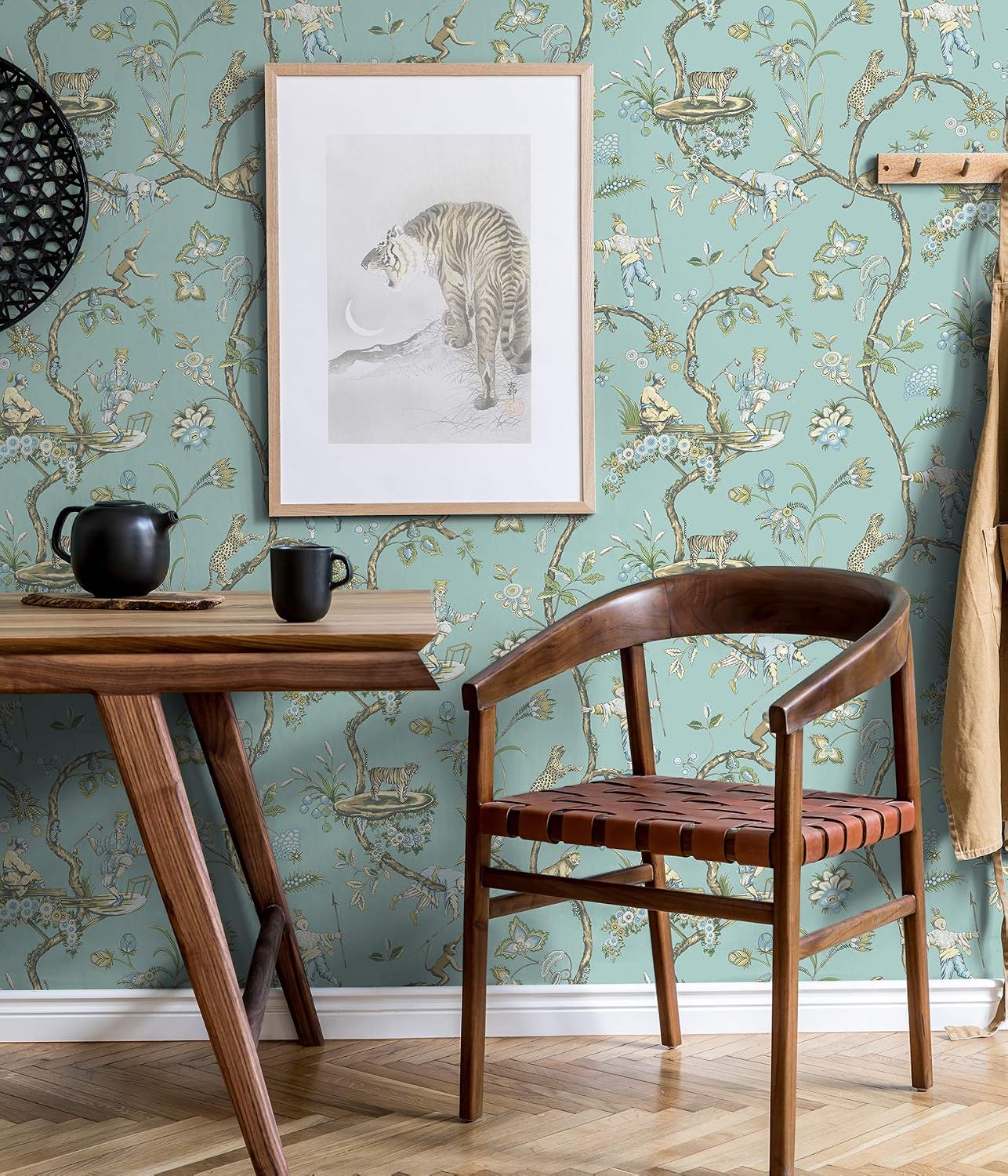
NuWallpaper
$51.50
In stock on Amazon
Check price on AmazonMid-Tier: Non-Woven Hybrid Brands
Several mid-market specialty retailers carry chinoiserie patterns printed on non-woven substrates with peel-and-stick conversion. Pattern fidelity here varies by designer and print run rather than by a unified archive. The better offerings in this tier read well at a distance and hold color across rolls ordered in the same batch. The risk is consistency on large orders: dye-lot management — the process of ensuring color matches between separate print runs — is less systematic than at a licensed-archive operation, so it is worth confirming batch sourcing before finalizing a multi-roll order.
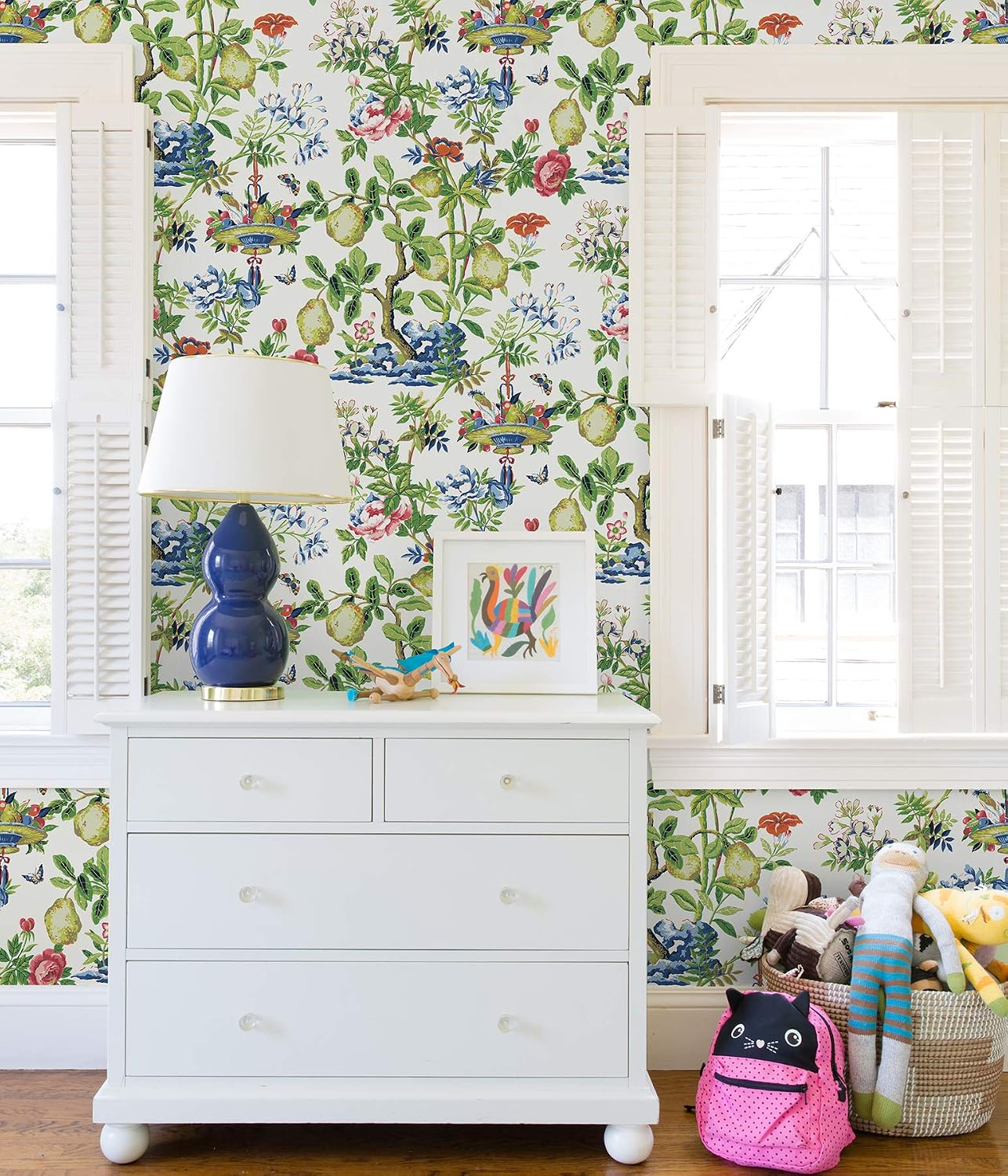
NuWallpaper
$43.23
In stock on Amazon
Check price on AmazonBudget Tier: Print-on-Demand and White-Label
Spoonflower’s print-on-demand platform is the standout in this tier. Independent surface designers sell original chinoiserie patterns there, and Spoonflower’s quality control on their peel-and-stick wallpaper has been rated consistently in the mid-to-high range by reviewers in Apartment Therapy coverage of the category. The genuine risk in this tier is the anonymous white-label product — often listed under multiple brand names on mass marketplaces — where print resolution drops and color matching between roll batches becomes a real problem on multi-wall installations. If you cannot identify the manufacturer or confirm a dye-lot policy, treat the product as single-wall-only material.
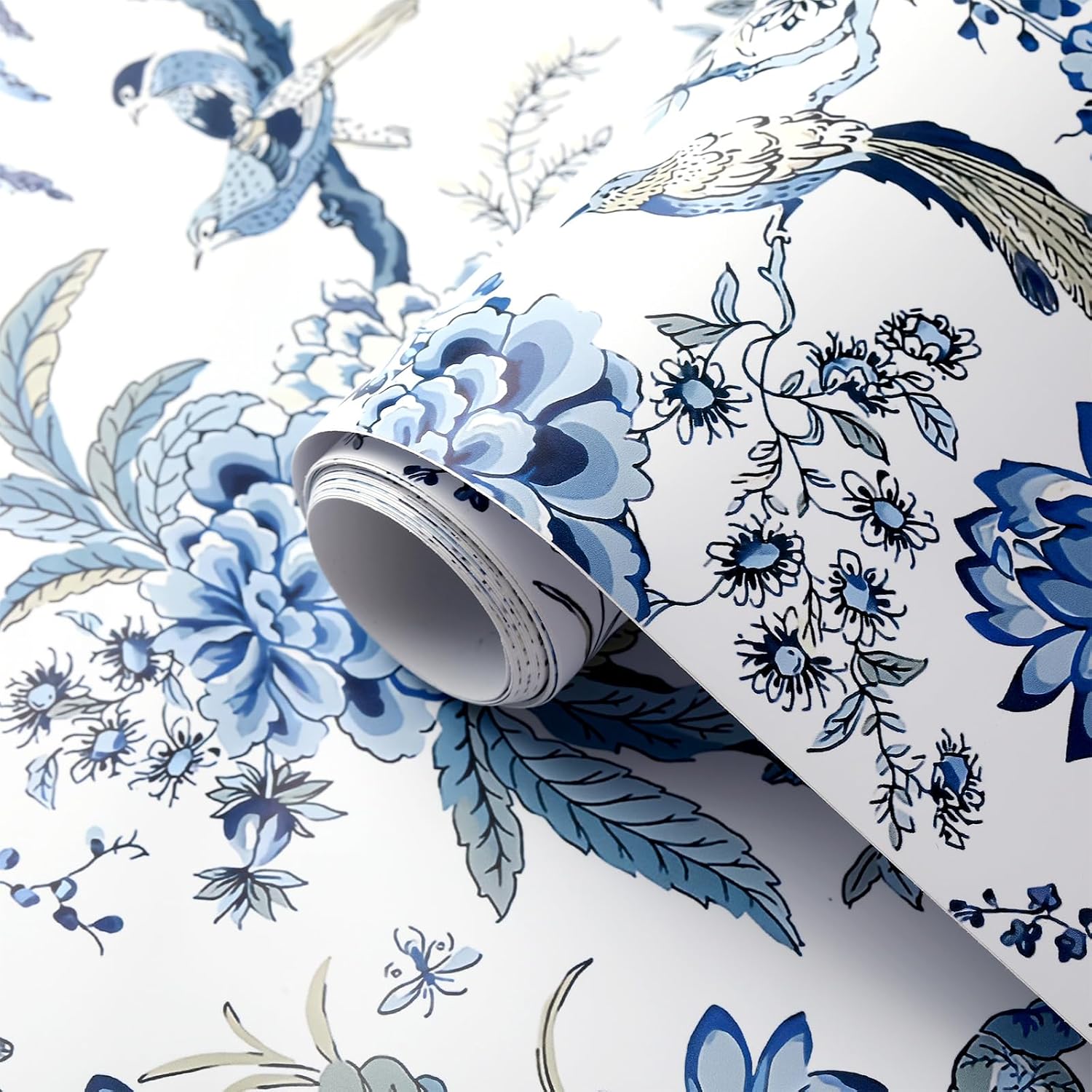
Drydiet
$14.99
In stock on Amazon
Check price on AmazonSubstrate Audit: Peel-and-Stick Is Not One Thing
“Peel-and-stick” describes an installation method, not a material quality tier — and this is where intermediate practitioners sometimes get tripped up. House Beautiful’s 2024 chinoiserie feature, “Chinoiserie Wallpaper Is Having a Moment — Here’s How to Shop It,” makes this point directly: the adhesive backing is the variable you can see, but what matters equally is what’s underneath it.
Premium Tier: Vinyl Composite with Matte Finish
NuWallpaper x Scalamandré prints on a vinyl-composite substrate with a matte finish. Published specification sheets from the NuWallpaper x Scalamandré collection (2024–2025) describe it as repositionable — you can peel and re-adhere without immediate adhesive failure — with a manufacturer rating for smooth, primed drywall surfaces. The product is not rated for textured walls without a liner (a flat intermediate layer, usually a non-woven fabric or paper, applied to the wall first to create a smooth field). Design professionals speccing this in hospitality contexts consistently flag that textured walls need liner prep regardless of price point.
This substrate is solid for its intended use case: smooth, primed drywall in residential settings. It is not the most forgiving substrate on imperfect surfaces, and that is worth factoring into your pre-install assessment.
NuWallpaper
$51.50
In stock on Amazon
Check price on AmazonMid-Tier: Non-Woven Hybrid
Non-woven wallpaper with a peel-and-stick conversion is the current sweet spot for renters who want longevity without commitment. This substrate has the dimensional stability of traditional wallpaper with the convenience of no-paste installation. It tends to be more forgiving on slightly imperfect surfaces than thin vinyl film, and seams on matte non-woven finishes are less visible than on high-gloss PVC options. For a client-facing install on walls that are not perfectly smooth, this substrate edges out vinyl composite for practical reasons. Architectural Digest’s 2024 piece “The Case for Statement Wallpaper in Every Room” notes that non-woven peel-and-stick hybrids have become the preferred specification for designers who need both ease of installation and a finish that photographs well.
NuWallpaper
$43.23
In stock on Amazon
Check price on AmazonBudget Tier: Fabric-Based and Thin PVC Film
Budget chinoiserie substrates split into two distinct categories. Fabric-based peel-and-stick — used by some Spoonflower options — offers a softer hand, is forgiving on slight surface irregularities, and tends to show seams less on matte finishes. Easier repositioning during installation is a commonly cited advantage in user reviews aggregated by Apartment Therapy’s peel-and-stick coverage. Thin PVC film, common in the lowest-price-point white-label products, prints crisply but is less forgiving during installation: air bubbles are harder to work out, and the adhesive layer is often thinner, leading to edge lift in humid environments like bathrooms or kitchens.
The thin PVC category is not categorically unusable, but you have no way to verify it isn’t problematic before the rolls arrive without a sample. That single fact is a disqualifier on any project where surface finish accuracy matters.
Drydiet
$14.99
In stock on Amazon
Check price on AmazonComparison at a Glance
The table below summarizes the four tiers across the key decision variables. Each row is keyed to the tier markers used throughout this article.
| Tier | Approx. Price/Roll (2026) | Substrate Type | Dye-Lot Consistency | Sample Policy |
|---|---|---|---|---|
| NuWallpaper x Scalamandré | $40–$60 | Vinyl composite, matte | High (licensed archive) | Free, no minimum |
| Mid-market non-woven hybrid | $55–$110 | Non-woven hybrid | Medium-high | Paid, usually credited |
| Spoonflower print-on-demand | $25–$55 | Fabric or non-woven | Variable by designer | Single-swatch available |
| White-label thin PVC | $12–$30 | Thin PVC film | Low | Rarely available |
NuWallpaper
$51.50
In stock on Amazon
Check price on AmazonNuWallpaper
$43.23
In stock on Amazon
Check price on AmazonDrydiet
$14.99
In stock on Amazon
Check price on Amazon(Prices reflect standard single-roll pricing as of mid-2026; trade accounts and bulk orders typically reduce these figures 15–30%.)
Sample Policy: The Variable That Actually Protects Your Client
The sample policy is as important as the product itself. On a $3,000-plus installation, the cost of a wrong decision dwarfs the cost of three sample rounds. Architectural Digest’s 2024 piece “The Case for Statement Wallpaper in Every Room” frames the design community standard as ordering across multiple colorways and lighting conditions before committing to a full order — a practice that requires a functional sample program.
Premium Tier: Free Samples, Low Friction
NuWallpaper offers free samples through its website for most patterns in the Scalamandré collaboration. Sample size is typically 8 inches by 10 inches — large enough to assess color accuracy and surface finish, but not quite large enough to evaluate the full repeat on a chinoiserie pattern where the design cycle can run 24 to 36 inches vertically. The professional workaround: order two samples and align them to visualize the repeat. The free-sample model removes friction on projects where you are validating multiple colorways simultaneously, and that low barrier is a genuine operational advantage at the specification stage.
NuWallpaper
$51.50
In stock on Amazon
Check price on AmazonMid-Tier: Paid Samples, Usually Credited
Most mid-market specialty wallpaper retailers offer paid samples in the $3–$8 range, often credited toward the full order. This is a reasonable model for professional use, though it adds a step when validating multiple options simultaneously. Confirm before ordering whether the sample cost applies to the final purchase — policies vary by retailer, and the difference matters on a project where you are running five or six colorway comparisons.
NuWallpaper
$43.23
In stock on Amazon
Check price on AmazonBudget Tier: Spoonflower Yes, White-Label Often No
Spoonflower has a well-documented sample program — you can order a single swatch of any pattern before committing to a full roll. Design professionals and reviewers cited in Apartment Therapy’s 2025 peel-and-stick roundup, “The Best Peel-and-Stick Wallpapers, According to Renters and Design Pros,” name this as one of Spoonflower’s strongest differentiators, especially for custom or independent-designer patterns where colorway accuracy is otherwise unverified.
White-label and mass-marketplace products frequently have no sample option, or offer samples at a per-unit cost not credited toward the full order. This is a practical disqualifier on any project where substrate, finish, or color accuracy matters. The decision rule is clean: if a vendor will not offer a sample, price that product as if you are accepting full installation risk — because you are.
Drydiet
$14.99
In stock on Amazon
Check price on AmazonTrue Installed Cost: Modeling the Real Number
The roll price is not the project price. This is where intermediate practitioners most often underestimate the budget gap.
For a standard dining room (12 ft × 14 ft, 9 ft ceilings, four walls, two standard windows and one door):
Total wall area minus openings runs approximately 330 square feet. At a standard peel-and-stick roll coverage of 20–28 square feet per roll — chinoiserie repeats can be long, which increases waste — you are looking at 13–17 rolls.
True cost components on top of roll price:
- Pattern repeat waste: Long-repeat chinoiserie (18-inch-plus vertical repeat) can add 15–25% to your roll count. Budget options with compressed or tiled repeats waste less material but often read as less authentic at scale.
- Liner (if needed): On textured walls, a non-woven liner runs $0.50–$1.50 per square foot installed. For 330 square feet: $165–$495 before installer labor.
- Installation labor: Peel-and-stick is DIY-friendly on smooth, primed drywall. But chinoiserie pattern-matching at seams benefits from an experienced hand. A single-room installation from an NGPP-certified specialist — the National Guild of Professional Paperhangers, whose certification indicates training in pattern matching, seam finishing, and substrate assessment — runs $200–$600 for a dining-room-scale project in most U.S. markets as of 2026.
Decision rules by scenario:
- Rental, smooth walls, one accent wall, budget under $400 total: NuWallpaper x Scalamandré is the strong call. Pattern provenance is defensible, the free sample removes risk, and the all-in cost stays manageable.
- Multi-wall, textured surfaces, or a client-facing install: Budget an NGPP-certified installer regardless of which product you choose. The substrate difference between vinyl composite and mid-market non-woven hybrid matters more on difficult walls — non-woven tends to be more forgiving.
- High-traffic hospitality space or a principal bedroom with longevity expectations beyond five years: Peel-and-stick at any price point is not the right substrate. House Beautiful’s 2024 chinoiserie feature “Chinoiserie Wallpaper Is Having a Moment — Here’s How to Shop It” and Architectural Digest’s 2024 piece “The Case for Statement Wallpaper in Every Room” both note this threshold — peel-and-stick is a lifestyle product, not a commercial durability solution. The conversation shifts to Type II commercial vinyl or hand-painted panels at that point.
- Budget chinoiserie from a vendor with no sample policy: Stop. That is a known risk with no upside. Move to a vendor with a sample program before proceeding.
The Bottom Line
NuWallpaper x Scalamandré earns its price premium in exactly two places: pattern provenance (the Scalamandré archive is real and it shows in the final product) and sample policy (free, low-friction, no minimum). On substrate, it is competitive but not exceptional — the vinyl composite is solid for smooth drywall, but mid-market non-woven hybrids edge it out for installation flexibility on imperfect walls.
Budget chinoiserie is not categorically inferior. Spoonflower’s platform offers genuine pattern diversity and a legitimate sample program that makes it a serious option for the right project. The category to avoid is the no-sample, thin-PVC-film white-label product — not because it is always bad, but because you have no way to verify it is not before the rolls are on your wall.
Order the samples first. Model the true installed cost with liner and labor included. Then make the call.
Ready to calculate how many rolls your room actually needs? Use our panel calculator to model your order with repeat-waste factored in.