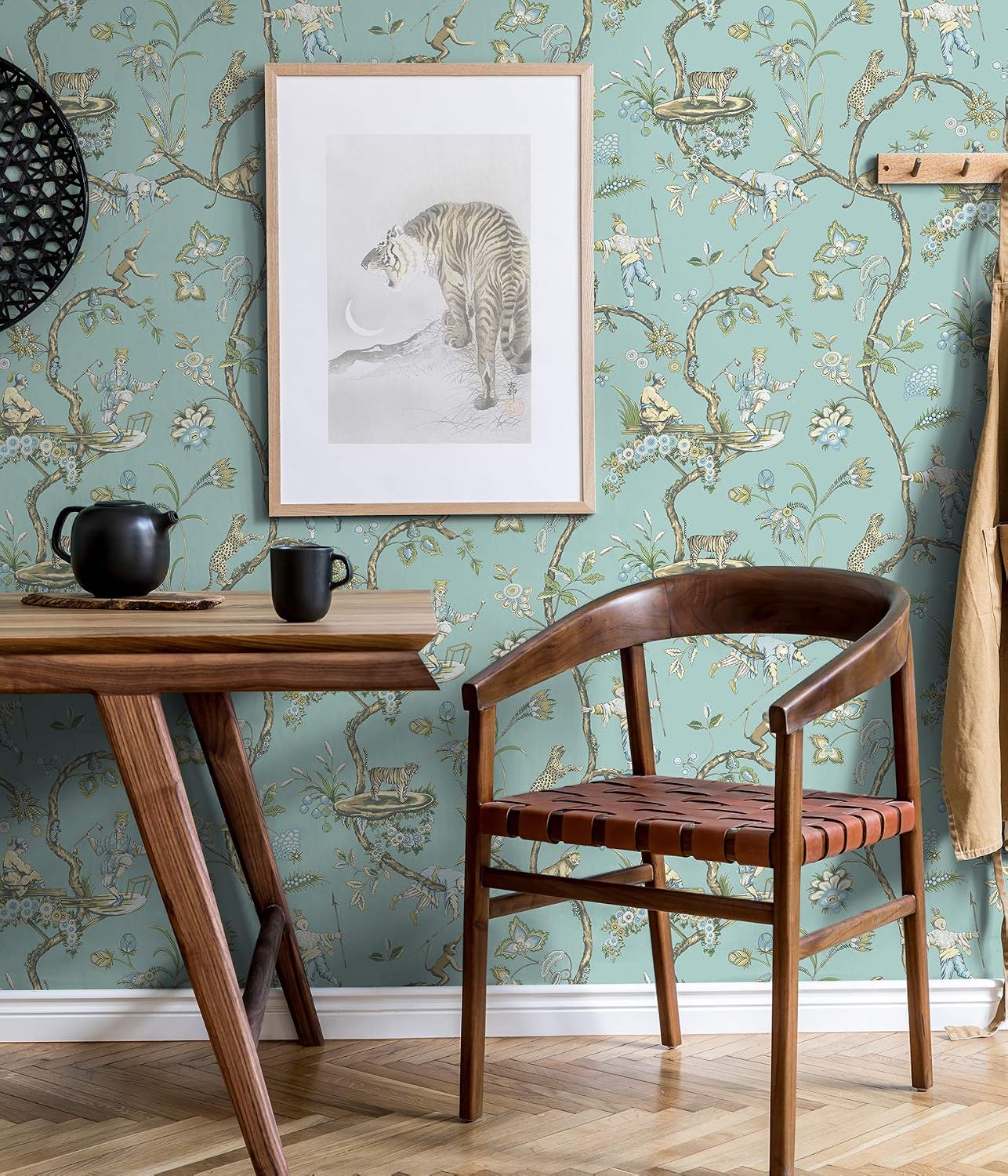
You just found the most gorgeous chinoiserie wallpaper on Instagram — dramatic cranes, trailing peonies, misty mountains rendered in sage and blush — and it comes in a peel-and-stick format you can actually afford and hang yourself. Before you calculate square footage and hit checkout, slow down for one decision that will determine whether this project becomes a room transformation or a $300 mistake you’re peeling off a wall at midnight.
Chinoiserie (say it: sheen-WAH-zuh-ree) is a centuries-old European design tradition that reimagines East Asian art — pagodas, flora, birds, landscapes — with a slightly fantastical, painterly quality. In wallpaper form, it typically arrives as a large-scale mural or repeating panel pattern that commands an entire wall. Peel-and-stick wallpaper is exactly what it sounds like: a pressure-sensitive vinyl or fabric-backed product that adheres without paste and, in theory, removes cleanly later. The combination sounds perfect. But the gap between how chinoiserie looks on a four-inch monitor swatch and how it reads across 12 feet of wall is where projects go sideways. This guide walks you through the tradeoffs practitioners already know and the sample process that closes most of the risk before you spend a dollar on full rolls.
Why Chinoiserie Is Especially Unforgiving in Peel-and-Stick Format
Most wallpaper categories carry some sampling risk — color shifts under different light sources, pattern repeats that look balanced in a thumbnail can feel relentless at room scale. Chinoiserie amplifies every one of those risks for three structural reasons.
Scale mismatch is endemic to the category. Chinoiserie designs are historically conceived as large-format murals — the original de Gournay and Gracie Studio installations run floor-to-ceiling, sometimes across eight or ten bespoke panels. When those compositions get adapted into repeating peel-and-stick tiles for the $40–$120 price tier, the motifs are often compressed. A crane that should span 30 inches reads as a crowded, almost claustrophobic repeat at every 18 inches. Architectural Digest’s coverage of the chinoiserie revival in contemporary interiors specifically flags “motif scale relative to room height” as the variable most buyers underestimate. You will not see this on a product thumbnail.
Colorway fidelity varies dramatically between manufacturers. Chinoiserie palettes — particularly the soft sage-on-cream, the dusty blush, the aged indigo — are notoriously difficult to reproduce accurately in digital print. House Beautiful’s wallpaper trend coverage notes that hand-painted originals derive their warmth from pigment layering that flat inkjet processes struggle to replicate. In peel-and-stick products, the substrate (the backing material) also influences perceived color: a slightly warm ivory base makes that sage greenish-gray read as olive; a cooler white base pushes it toward mint. Neither is wrong, but one is definitely not what you ordered.
Seaming is visible in a way it isn’t with geometric or abstract patterns. Chinoiserie’s organic, flowing motifs — branches that drift across panels, birds mid-flight — have no visual tolerance for seam misalignment. Even a two-millimeter slip breaks the illusion entirely. Peel-and-stick products, because they’re repositionable, are actually more prone to seam creep during application than paste-the-wall products, which lock in position as they dry. The Spruce’s installation guide for peel-and-stick wallpaper explicitly warns that “organic patterns with no clear grid reference point require the most precise hanging” — and chinoiserie is almost always that category.
The Sample-First Decision Framework: What You’re Actually Evaluating
Ordering four to six samples before committing to a full-wall purchase is standard practice on this site. With chinoiserie peel-and-stick specifically, here’s what each sample evaluation step is actually testing for, and how to run it correctly.
1. Color under your room’s actual light sources
Pin the sample to your intended wall and observe it at three points: morning light, midday, and evening with your artificial lighting on. This is non-negotiable for chinoiserie because the palette relies on subtle tonal relationships. Apartment Therapy’s buyer guide for peel-and-stick products notes that “samples observed only under one light condition fail to reveal the full range of how color will behave.” A dusty rose that reads perfectly feminine at noon can shift warm and muddied under incandescent light at 8 p.m.
2. Motif scale relative to your actual ceiling height
Tape your sample to the wall and step back to the room’s natural vantage point — usually six to ten feet. Ask: does the repeat feel generous or crowded? For chinoiserie, the general practitioner rule is that motifs should feel slightly larger than you expect in person, because the pattern’s complexity creates visual density that smaller motifs can’t sustain at distance. Wallpaper Magazine’s analysis of statement wall trends identifies “motif-to-room-height ratio” as the defining spec for large-scale organic patterns.
3. Backing adhesion on your specific wall substrate
This is where peel-and-stick’s notorious variability shows up. The product may be rated for painted drywall, but your painted drywall might have a flat latex finish (low grip), an eggshell finish (moderate grip), or a freshly painted surface (almost always problematic for 60–90 days after painting). Test the sample in an inconspicuous corner. Press it firmly, leave it 24 hours, and attempt a slow, 45-degree-angle peel. If it pulls paint or resists cleanly removal, your wall prep needs to change before installation day. The Spruce’s installation guide recommends a wall primer specifically designed for peel-and-stick wallpaper on any wall painted fewer than three months prior.
4. Seam quality at pattern repeat
If the seller provides samples large enough to show two panel widths, butt them together and evaluate the join. Most reputable suppliers — Spoonflower, Society6, and comparable direct-print vendors — will send samples that represent a single panel. Ask explicitly if they can send a matched pair. If they can’t or won’t, that’s a data point about their pattern registration confidence.
By the Numbers: What a Full-Wall Chinoiserie Peel-and-Stick Project Actually Costs
| Cost Component | Typical Range (2026) |
|---|---|
| Peel-and-stick panels (150 sq ft accent wall, entry-tier) | $120 – $340 |
| Sample order (4–6 panels, some suppliers deduct from purchase) | $15 – $60 |
| Smoothing tools, seam roller, trim knife | $18 – $35 one-time |
| Wall primer (if surface prep required) | $22 – $45 |
| Professional installer (optional but recommended for large murals) | $200 – $600 |
| Total true cost range | $175 – $1,080 |
The wide installer range reflects whether your project is a 60-square-foot powder room or a 200-square-foot dining room with high ceilings. If you’re sourcing a mid-market chinoiserie panel from a vendor like Burke Décor or Anthropologie’s wallpaper line (typically $200–$500 for a mural set), the sample investment of $15–$60 is genuinely cheap insurance against a non-refundable full order.
The Tradeoffs Practitioners Need to Name Explicitly
Peel-and-stick vs. paste-the-wall for chinoiserie: it’s not just about renting
The common framing is that renters choose peel-and-stick and homeowners choose paste. That framing misses the real tradeoff. Paste-the-wall chinoiserie (unpasted product applied with paste directly to the wall surface) gives you significantly better seam control and adhesion on complex organic patterns — because paste allows more working time before it locks. Peel-and-stick’s repositionability is an advantage for simple geometric patterns but becomes a liability for chinoiserie, where every repositioning risks pulling the edge and stretching the vinyl backing microscopically, which throws off the next seam.
If you own your space and are considering a permanent chinoiserie installation in a dining room or bedroom, the honest decision tree is: peel-and-stick buys you flexibility and speed; paste-the-wall buys you seam quality and longevity. For a $250 job in a rental, flexibility wins. For a $600 dining room installation you want to last five years, paste-the-wall is worth the extra complexity.
When to hire an NGPP-certified installer
NGPP stands for the National Guild of Professional Paperhangers — the trade body that certifies professional wallpaper installers in the U.S. For peel-and-stick chinoiserie in the $40–$150 range, a DIY installation with careful prep is reasonable. But if you’re spending $400 or more on a mural set with large-format panels and complex motif registration, the cost of a botched DIY installation — including the cost of replacement panels — frequently exceeds the cost of hiring a certified professional in the first place. Get quotes from at least two NGPP members before deciding.
If X, Then Y: The Decision Rules
If your wall was painted fewer than 90 days ago: Do not install peel-and-stick yet. Prime with a peel-and-stick-specific primer, wait the manufacturer’s recommended cure time, and re-test adhesion before ordering full panels.
If the chinoiserie pattern features continuous motifs (birds in flight, trailing branches) rather than contained medallions: Budget for a professional installer regardless of panel cost. Seam registration on continuous organic patterns is the single hardest DIY challenge in wallpaper installation.
If your sample shows color that reads differently than the product photography by more than one visible tonal step: Email the vendor before ordering. Ask whether they can provide a color-corrected sample or confirm print-run consistency. If they can’t, treat that as a signal to source elsewhere.
If you’re working with a budget under $200 for the full wall: Prioritize vendors that allow sample orders to be credited toward a full purchase (Spoonflower’s model, for instance, applies sample costs to full orders). Your true risk exposure at this budget is low enough that one sample round is sufficient.
If you’re sourcing for a hospitality project (hotel room, boutique lobby): Peel-and-stick is not the right substrate for high-traffic commercial spaces regardless of chinoiserie’s visual appeal in the category. Commercial-grade Type II wallcovering with a commercial-rated adhesive is the correct spec — the conversation shifts to fire rating (Class A surface-burning characteristics under ASTM E84) and seam durability under cleaning protocols.
Your Next Step
Order your samples first — ideally four to six, covering the panels that will anchor your most-visible wall section. Pin them up, live with them for 48 hours across different times of day, and run the adhesion test described above before you touch the full-order button. If you’re unsure how many panels your wall actually requires, use a room-scale panel calculator before placing any order. Getting the panel count wrong — especially on a non-refundable mural set — is the other major source of project regret, and it’s entirely preventable.
The chinoiserie moment in contemporary interiors is real and well-documented across sources from Architectural Digest to Wallpaper Magazine. The peel-and-stick format has democratized access to that aesthetic in a genuine way. But democratized access doesn’t mean the decisions are simpler — it means the decisions are yours to make, without a trade professional in the room guiding you. Sample first, then commit.