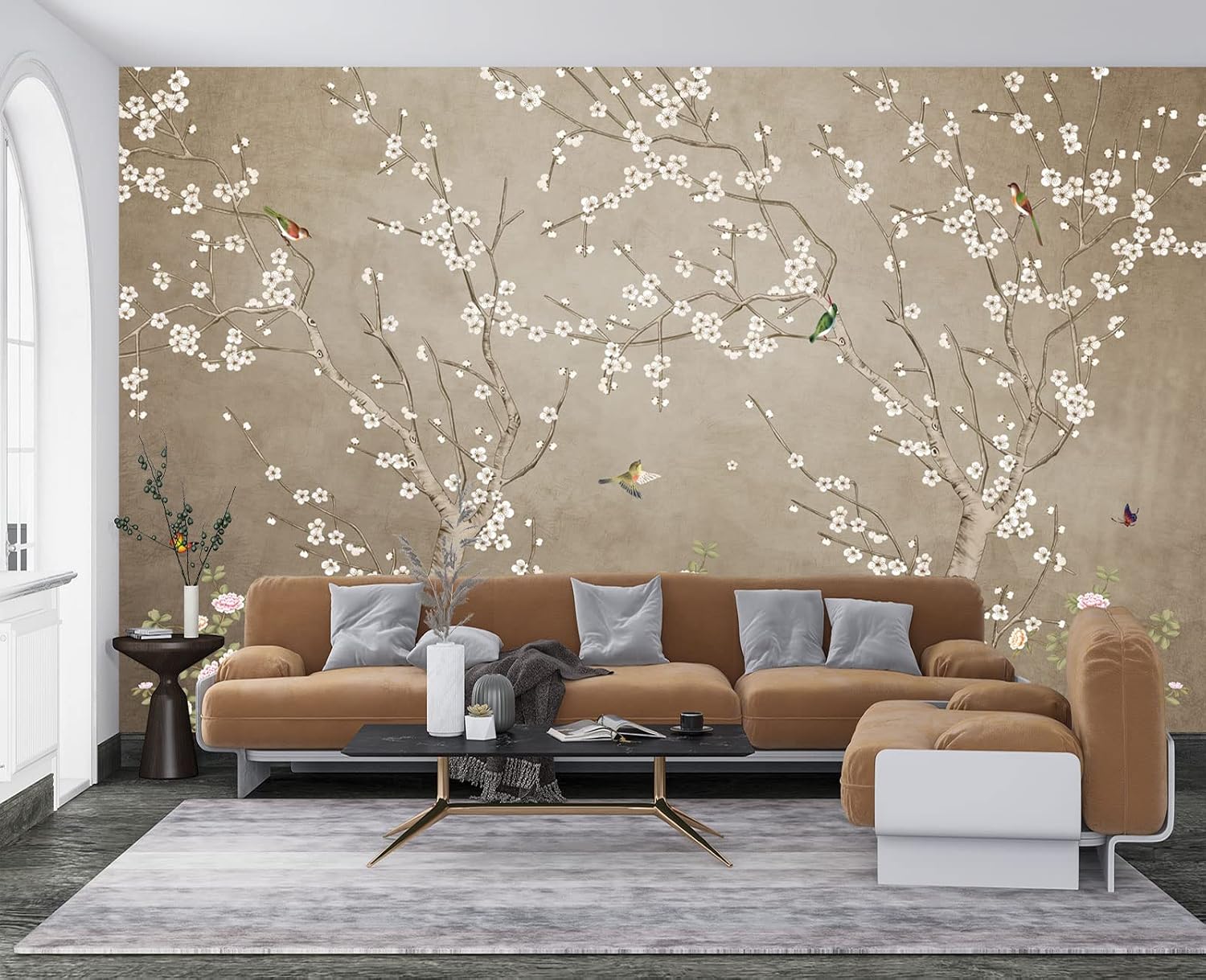
You found a chinoiserie mural — those lush, hand-painted scenes of flowering trees, birds, and mountain landscapes that have been decorating European and American interiors since the 18th century — on a designer’s Instagram, and now you’re trying to figure out how it actually gets onto your wall. Chinoiserie (pronounced sheen-wah-ZUR-ee, from the French word for “Chinese-style”) wallpaper is almost always sold as a coordinated set of numbered panels — wide vertical sheets that tile across a room to create one continuous scene. Unlike repeat-pattern wallpaper that tiles predictably, mural panels are site-specific: the art wraps your room once, edge to edge, and every measurement decision you make upstream locks in the composition on delivery day. This article walks you through the three decisions that trip up even experienced buyers: how panels are sized and ordered, what lead times actually mean for your project schedule, and why the industry’s sample policies create a gap you need to plan around.
| EDITOR'S PICKPlum Blossom Flower Bird Chinoi… | Mid-tier[Murwall Chinoiserie Wallpaper W…](https://www.amazon.com/dp/B09RQYJ3VT?tag=greenflower20-20) | Budget pick[VaryStyle Chinoiserie Landscape…](https://www.amazon.com/dp/B0CXSW5NRP?tag=greenflower20-20) | |
|---|---|---|---|
| Size | 137" x 100" | — | — |
| Peel & Stick | ✗ | — | ✓ |
| Theme | Flower Bird | Watercolor Peony | Landscape |
| Colorway | — | — | Navy Blue/Green |
| Price | $109.99 | $29.00 | $18.68 |
| See on Amazon → | See on Amazon → | See on Amazon → |
How Panel Sizing Actually Works — and Why Your Wall Dimensions Are the Starting Point
Chinoiserie murals are not sold by the roll. They’re sold as panel sets — typically between four and twelve vertical panels — designed to wrap a room or cover a single feature wall. Each house handles sizing differently, and confusing the systems is the single most common ordering error documented in installer forums and trade reviews.
The three dominant sizing models you’ll encounter:
1. Fixed-width, custom-height (de Gournay, Fromental). De Gournay’s client documentation specifies panels in fixed widths — typically 90 cm (approximately 35.5 inches) — with height made to order at the time of commission. You submit your ceiling height to the nearest centimeter and the studio paints or prints to that dimension. The advantage: the composition is calibrated exactly to your room. The tradeoff: there’s essentially zero material left over for installation errors. Fromental’s trade brief similarly warns that “all dimensions are taken as finished, trimmed wall dimensions” — meaning your installer must measure to within 5 mm before the order is placed.
2. Panel sets with fixed overall width (Gracie Studio). Gracie’s custom mural panels are quoted as a complete room package. The studio’s product specifications note that clients supply the exact perimeter in linear feet, including door and window openings, and Gracie designs the scene to flow around those interruptions. The finished panels arrive pre-numbered and positioned. This is the most compositionally elegant approach, but it requires your floor plan to be finalized before the design conversation begins — not during it.
3. Modular tile or repeat-panel systems (mid-market, Anthropologie, some Burke Décor collections). A handful of mid-market brands sell chinoiserie-adjacent murals as modular grids — fixed-size panels (often 24”×48” or 50 cm×100 cm) that you combine to fill your wall. These are far more forgiving of measurement imprecision, but they require careful layout planning to avoid awkward partial panels at corners. House Beautiful’s 2024 mural installation guide flags “corner math” as the leading cause of mid-installation surprises in modular systems.
The panel count formula you need before you call anyone:
Number of panels = Room perimeter ÷ Panel width (round up, not down)
But here’s the nuance: “room perimeter” in mural math is not always the full perimeter. If you’re wrapping three walls of a dining room and leaving the fourth (a windowed wall) bare, you measure only those three walls. If you have a centered door you want the scene to flow past, you include that width. Architectural Digest’s 2023 chinoiserie overview recommends always adding one extra panel to any order “for installation insurance” — a $400–$900 buffer that most designers quietly build into their quotes.
By the numbers — a 14-foot-wide dining room wall, de Gournay fixed-width model:
| Wall width | Panel width | Raw panel count | Recommended order |
|---|---|---|---|
| 14 ft (427 cm) | 90 cm | 4.75 → 5 panels | 6 panels |
| True cost implication | +1 insurance panel | ~$800–$1,200 extra | Standard trade practice |
Lead Times: The Calendar Math That Derails Hospitality Projects
If you’re pricing chinoiserie murals in May 2026 and hoping for an autumn install, you’re already in a tight window. Here’s what the lead time landscape looks like right now.
Bespoke hand-painted (de Gournay, Gracie Studio): Published lead times in the studios’ current client documentation range from 16 to 26 weeks for fully custom, hand-painted commissions — and that clock starts only after the final design proof is approved, not when the deposit clears. Factor in two to four weeks of back-and-forth on colorway adjustments, and a May contract signing realistically yields a September or October delivery at best. For principal bedroom or boutique hotel lobby projects, that timeline is workable. For a gala or property opening with a fixed date, it’s a scheduling risk.
Printed bespoke (Fromental, Timorous Beasties digital prints): High-end digitally printed murals — which use archival inks on silk, grasscloth, or heavyweight non-woven substrates — typically run 8 to 14 weeks. Fromental’s trade brief lists substrate choice as the biggest lead time variable: silk panels require additional handling and can add two to three weeks versus a non-woven base. If your deadline is firm, ask the studio to specify the substrate lead time separately from the printing lead time.
Mid-market semi-custom (Anthropologie, some Photowall collections): Expect 3 to 6 weeks, with standard shipping. These panels are typically printed on demand from a digital master, with limited colorway flexibility. The tradeoff for shorter lead times is the loss of the fine compositional control you get from fully bespoke work.
Entry-level on-demand (Spoonflower, Society6): Production runs 7 to 14 business days. These are real chinoiserie-inspired designs — not hand-painted originals — and are well-suited to rental spaces, nurseries, or a first mural project where you’re building your eye before committing to a bespoke budget.
The calendar rule for hospitality PMs: Back-calculate from your install date. Add 5 business days for shipping and customs clearance (for European studios shipping to the US, UK import duties and US Customs documentation add processing time that studios cannot fully control). Add your installer’s scheduling lead — NGPP-certified specialists in major metro markets typically book 3 to 6 weeks in advance for large-format specialty work, per the NGPP’s 2024 installation standards guide. Add the studio’s production lead. That sum is your drop-dead order date.
The Sample Policy Gap — and How to Work Around It
Here’s the tradeoff nobody surfaces clearly in brand marketing: the studios whose work you most want to sample are often the ones with the most restrictive sample policies.
De Gournay’s client documentation is explicit: the studio does not offer free samples. Physical memo samples — small reference swatches — are available for purchase, and returnable A3-size (roughly 12”×17”) color reference panels can be requested through trade accounts, but a returnable deposit applies. This is not unusual for a studio where hand-painting a sample carries real labor cost. The design implication is significant: you are approving a full-room commission largely from digital proofs and small swatches that cannot replicate the scale of the finished installation.
Gracie Studio similarly structures the sampling conversation around trade accounts, with colorway references shared at in-person studio appointments or through authorized showrooms. Their product specifications encourage buyers to visit the New York showroom before finalizing any colorway — practical for East Coast designers, less so for international clients or buyers in secondary markets.
Fromental’s trade brief offers a slightly more structured sampling pathway, with strike-offs — test prints on the specified substrate — available to trade clients at cost. If your contract permits it, requesting a substrate strike-off before final approval is the closest equivalent to a true sample.
What the sample gap means in practice:
The industry standard this site consistently reinforces — ordering 4 to 6 samples before committing — is genuinely difficult to execute in the bespoke chinoiserie segment. The workaround experienced designers use:
- Request the physical memo swatch, not just a digital colorway. Even a 4”×6” hand-painted swatch shows brush texture, paint depth, and substrate sheen in a way no monitor calibration replicates.
- Photograph your wall under the room’s actual lighting — both natural and artificial — and compare the swatch in that light, not in the studio or showroom.
- For mid-market projects, Photowall and Photowall-adjacent services offer returnable A2 or full-panel samples at low cost. Use them. House Beautiful’s installation guide calls this “the most underused tool in mural planning.”
- Commission a colorway proof before full production sign-off. Most bespoke studios will produce a small proof section of the final design for an additional fee. It is worth budgeting for this — typically $150 to $400 — on any project where the installation cost alone exceeds $1,500.
The Decision Framework: If X, Then Y
If your ceiling height is non-standard (under 8 ft or over 10 ft), work only with studios offering custom-height panels — fixed-size modular systems will either leave a gap or require awkward trimming that breaks the composition.
If your project has a fixed open date (hotel launch, staged listing, event), add 10 weeks to any bespoke studio’s quoted lead time before you commit. If that math doesn’t work, step down to a printed bespoke option with an 8–10 week window and use the budget difference on an NGPP-certified installer.
If you cannot get a physical swatch before approval, budget for a colorway proof. The math is simple: a $200–$400 proof protects a $3,000–$8,000 commission. Don’t skip it.
If you’re in the mid-market tier ($200–$800 for the panels), the sample calculus flips — sample panels are accessible and inexpensive, and there’s no reason to order without seeing a full A2 or A1 proof at scale in your room’s light.
If your wall has architectural interruptions — doors, windows, niches, fireplaces — budget an additional panel for every major interruption and have your installer calculate the reveal (the amount of panel visible on either side of the opening) before the order is finalized.
The craft that goes into a hand-painted chinoiserie commission is genuinely remarkable — these are art objects that will outlast the furniture in the room. But the ordering process is less forgiving than almost any other decorating decision you’ll make. Measure precisely, sample as aggressively as the studio’s policy allows, and build the lead time math before you’re in a deadline crunch. When you’re ready to scope your wall and panel count, use our room-scale panel calculator to model the numbers before you pick up the phone.