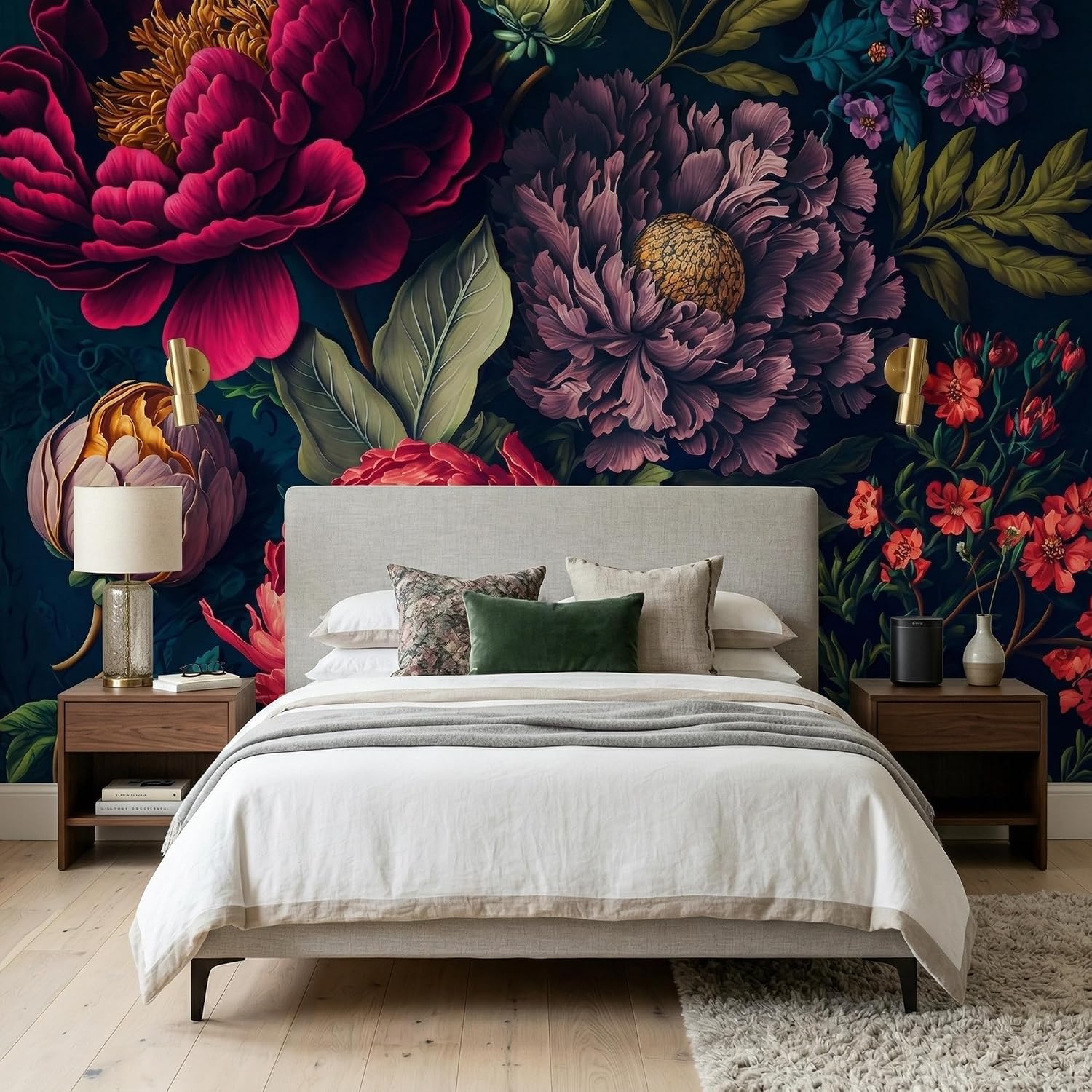
You just found a botanical mural on Instagram — cascading ferns, hand-painted silk panels, the kind of wall that makes a room feel like it grew there. You’ve screenshot it, sent it to your client, and everyone loves it. Now comes the part nobody warns you about: the gap between “I want that” and “that is installed correctly and looks exactly like the sample.” Botanical mural wallpaper — large-scale, nature-themed wall coverings sold as custom-printed or hand-painted panels rather than repeating rolls — sits at the intersection of fine art and construction materials. The decisions you make before the panels arrive determine whether the final wall is a triumph or an expensive headache. This guide walks through the three pressure points that trip up even experienced decorators: substrate (the wall surface the wallpaper bonds to), installer qualifications, and sample policies that protect you when a colorway ships wrong.
If you’re mid-negotiation on a project right now, the sections below are structured as decision frames, not background reading. Skip to the section that matches your current chokepoint.
| EDITOR'S PICK[Tropical Rainforest Botanical W…](https://www.amazon.com/dp/B0GLMNXRZ3?tag=greenflower20-20) | Mid-tier[MFWFM Jungle Wallpaper Tropical…](https://www.amazon.com/dp/B0BCWLRFJX?tag=greenflower20-20) | Budget pick[HAOKHOME Vintage Floral Wallpap…](https://www.amazon.com/dp/B0BZ46965Z?tag=greenflower20-20) | |
|---|---|---|---|
| Installation | Not Peel and Stick | Not Peel n' Stick | Peel and Stick |
| Size | 160"x108" | 161"x108" | 17.3in x 9.8ft |
| Theme/Vibe | Tropical/Leaf | Jungle/Palm | Vintage/Wm Morris |
| Brand | Tropical | MFWFM | HAOKHOME |
| Price | $139.99 | $139.99 | $16.99 |
| See on Amazon → | See on Amazon → | See on Amazon → |
Substrate: The Decision That Determines Everything Downstream
Substrate is the wallpaper industry term for the backing material the decorative surface is printed or painted onto — but in common usage on a job site, “substrate” also refers to the wall surface you’re adhering to. Both meanings matter here, and confusing them costs money.
The Wall You’re Hanging On
Botanical murals are typically sold as one of three material types: non-woven (a synthetic fiber sheet that paste-the-wall installations favor), paper-backed (traditional and common in hand-painted bespoke work), or fabric/silk (used by studios like Fromental and de Gournay for their highest-tier panels). Each behaves differently when it meets your actual wall.
The wall itself is your first variable. According to The Spruce’s overview of wallpaper substrate selection, the critical factors are:
- New drywall (less than 30 days cured) must be sealed with a primer-sealer before any wallpaper application — skipping this means the paper bonds to the surface gypsum layer, not the compound, and you’ll damage the wall on removal.
- Previously painted walls need a pH test. Alkaline surfaces (common in lime plaster, new concrete, or freshly skim-coated walls) cause adhesive failure on paper-backed murals, sometimes within weeks of installation.
- Plaster walls — common in pre-1960s homes and boutique hotels undergoing renovation — often require a wall lining (a plain paper layer hung first) to create a stable, dimensionally consistent surface. Fromental’s trade installation guidelines specifically require lining paper on all historic plaster before their silk panels go up.
The tradeoff you need to name for your client: Lining paper adds $3–$7 per square foot in labor and materials (2026 U.S. market rates from installer quotes aggregated in NGPP member forums), delays installation by one day minimum, and is non-negotiable for plaster or heavily textured walls. Skipping it to hit a deadline is the single most common cause of mural failure on historic properties. If your client is pushing back on lining paper, show them this sentence.
Non-Woven vs. Paper-Backed vs. Silk: The Real Tradeoffs
| Substrate Type | Installation Method | Moisture Tolerance | Removability | Typical Price Tier |
|---|---|---|---|---|
| Non-woven | Paste-the-wall | Moderate | Good (strips dry) | Mid-market ($200–$800/set) |
| Paper-backed | Paste-the-paper | Low | Moderate | Mid to bespoke |
| Silk/fabric | Professional only | Low | Poor | Bespoke ($1,000–$5,000+) |
Non-woven panels — the format used by mid-market suppliers like Fromental’s entry lines, Burke Décor, and Photowall — allow a paste-the-wall technique where adhesive goes on the wall, not the panel. This reduces the risk of the panel stretching or tearing during handling. Reviewers on design trade forums consistently note this format is more forgiving for installers with moderate (rather than specialist) experience.
Paper-backed murals are the traditional format for hand-painted work. Because the paper expands when wet with paste, seam alignment becomes a precision task — panels must be booked (folded paste-to-paste and left to relax for the manufacturer’s specified time, usually 5–10 minutes) before hanging. Gracie Studio’s trade FAQ notes that their panels ship with a specified booking time that must be followed exactly; deviation causes expansion mismatch at seams. This is not a job for a general contractor who “also does wallpaper.”
Silk and fabric panels (de Gournay, Fromental’s silk range, Timorous Beasties’ premium series) are in a category of their own. The decorative layer is adhered to a backing in the studio; the installer never pastes the face. But these panels are dimensionally sensitive to humidity, require a perfectly flat, primed, lined wall, and must be handled with cotton gloves. Architectural Digest’s 2025 feature on botanical wallpaper specifically called out that silk panel installations in humid climates (coastal properties, spa environments) require a full vapor barrier assessment before specification. If your project is in Miami or coastal South Carolina, this is not optional reading.
Installer Qualifications: The Certification That Actually Matters
Here’s the frame that experienced decorators use: for any mural over $800 total cost, the installer’s qualifications are part of the specification, not an afterthought.
The NGPP — the National Guild of Professional Paperhangers — is the primary professional credentialing body in the U.S. Their Certified Paperhanger (CP) designation requires demonstrated proficiency in specialty installations including murals, fabric wall coverings, and historic substrates. Per the NGPP’s certification overview, CP-holders must complete continuing education and attest to a minimum volume of professional work. This is not an automatic quality guarantee, but it is the baseline filter that separates professionals who regularly handle specialty materials from general contractors who hang standard rolls.
Decision rule:
- Peel-and-stick botanical panels (Spoonflower, Society6, budget Etsy murals): A competent general handyperson is adequate. These panels are forgiving, repositionable, and low-stakes.
- Non-woven paste-the-wall murals under $1,000 total: A paperhanger with documented mural experience — ask for a portfolio and two references from mural jobs — is sufficient. NGPP certification is a plus but not a hard requirement.
- Paper-backed murals over $1,000, any silk/fabric panel, any historic substrate: Hire an NGPP-certified installer. Require proof of certification before signing. For projects over $5,000 in panel value, ask whether the installer has worked with that specific studio before. De Gournay and Gracie Studio both maintain informal lists of approved installers in major markets; ask your trade rep for a referral.
What to Ask Before You Hire
Don’t rely on a general “have you done murals?” screen. Ask:
- What is your booking time for paper-backed panels, and how do you verify it?
- Have you worked on lining paper installations? What products do you prefer?
- How do you handle seam trimming on hand-painted panels where the pattern doesn’t repeat at a fixed interval?
- What is your process if a panel arrives with a colorway discrepancy?
That last question is a tell. A strong installer has a process because they’ve encountered it. A weaker one will say “I’d call the supplier” without being able to describe what happens next.
Sample Policy: The Fine Print That Protects Your Project
Wallpaper Magazine’s 2025 coverage of the scenic wallpaper market noted that colorway disputes — where the installed panel differs from the digital rendering or sample swatch the client approved — are among the most frequent sources of post-installation conflict in high-end residential projects. The sample policy you negotiate before ordering is your only contractual protection.
What “Sample” Actually Means by Tier
- Bespoke hand-painted studios (de Gournay, Gracie): Samples are small sections of actual painted substrate — sometimes 6 × 6 inches, sometimes a full panel quadrant. These are not printed color references. Gracie Studio’s trade FAQ specifies that their sample represents the colorway as it will ship; however, natural variation in hand-painted work means no two panels are identical. The standard of acceptance is “within the range of the sample,” not a pixel-perfect match.
- Custom digital-print studios (Fromental’s print lines, Photowall, many Etsy murals): Samples are digitally printed on the production substrate. Color calibration between your monitor and their print process is the critical variable. Request samples and evaluate them under the room’s actual lighting conditions — not in your office, not on screen.
- Mid-market production panels (Burke Décor, Anthropologie, Spacejet): Samples are cut from production rolls. For these, the risk is dye-lot variation between your sample run and your fulfillment run. Always ask whether your order will be fulfilled from the same production batch as the sample.
The Sample Policy Standard Worth Demanding
The site standard you should hold every project to: order four to six samples minimum before committing to a full panel order. This is not over-caution — it’s the only way to evaluate color under different lighting conditions (morning light vs. evening, artificial vs. natural), confirm substrate hand-feel (important for silk alternatives where texture affects light reflection), and catch colorway issues before they’re multiplied across 40 panels.
By the numbers:
- Average sample cost: $0–$35 per sample for most studios; some bespoke studios charge $75–$150 for hand-painted samples
- Average sample fulfillment time: 5–21 business days (longer for hand-painted studios)
- Cost of a colorway dispute on a full bespoke installation: potential full re-order, typically $2,000–$8,000+
- Break-even math: even at $150/sample × 6 samples = $900 — a fraction of one re-order
For hospitality projects, the sample evaluation should happen in the actual room if at all possible, or in a space with equivalent lighting. Wallpaper Magazine’s 2025 botanical feature noted that several boutique hotel projects experienced lobby mural disputes because samples were approved in a design studio under different light temperature than the installed space.
Cancellation Windows and Dye-Lot Protection
Read the cancellation window carefully. Most bespoke studios begin production within 48–72 hours of order confirmation. Some — particularly overseas studios operating on Asian time zones — begin within 24 hours. Once production starts, cancellation rights narrow significantly. The practical rule: your sample approval and your final order decision should happen in the same business day, or you risk a production start before you’ve confirmed colorway in-room.
For dye-lot protection, get the following in writing: “All panels for this project will be produced in a single production run from the same batch of materials.” This clause matters most for paper-backed and non-woven digital prints; hand-painted work is by definition variable, and that variability is part of the value proposition.
The Decision Framework: If X, Then Y
| Your situation | Your move |
|---|---|
| Historic plaster walls, any price tier | Budget for lining paper; require NGPP-certified installer |
| Silk or fabric panels from bespoke studio | Verify humidity/vapor conditions; require studio-approved installer |
| Paper-backed panels over $1,000 | NGPP-certified installer; confirm booking time protocol |
| Non-woven paste-the-wall under $800 | Experienced paperhanger with mural references; NGPP preferred |
| Peel-and-stick scenic panels | General installer is sufficient; focus your energy on sample review |
| Colorway is critical to client | Order 4–6 samples; evaluate in the installed room; get single-run commitment in writing |
| Hospitality project with humid environment | Silk panels require vapor assessment; non-woven or vinyl-backed formats are lower risk |
Your next step depends on where you are in the process. If you’re still in specification, use our room measurement calculator to model panel count and true-cost including installation before you present the budget to your client. If you’re past specification and into ordering, pull up the sample policy section above before you click confirm — the two minutes it takes to re-read the cancellation window is worth more than it sounds.